
Free daily spins at UK casinos in 2026: who actually runs them, what the rules allow, and how ten licensed brands compare
A “free spins every day” offer sounds like the most generous thing a casino can hand out — a small, free gift just for logging in. In practice, in the UK, that offer is shaped almost entirely by what the Gambling Commission does and does not allow, and the licence a casino holds is the only thing that proves it can run one at all. The headline number on the marketing page is rarely the interesting one; the wagering cap, the maximum conversion, and the slot it pins you to are. This page is built around that difference: which ten UK-licensed casinos run daily free spins legitimately, what their offers actually cost, and where the rules draw lines the marketing never mentions.
Currency stamp: current as of 7 November 2026; data checked against the Gambling Commission’s public register of gambling businesses.
Table of Contents
- How UK casinos pay out: the everyday plumbing behind a “free” spin
- What a UK daily free spins offer actually is
- The ten licensed brands running daily free spins in the UK
- The fundamentals of a UK free daily spins offer
- The legal frame: what the Gambling Commission actually requires
- What a 10x wagering requirement actually costs a player
- Responsible gaming at a UK free daily spins site
- Frequently asked questions
How UK casinos pay out: the everyday plumbing behind a “free” spin
The payment side of any UK online casino matters more than it looks for a daily-spins reader, because most days a player at a free-spins casino never deposits anything. The transaction chain is short: a deposit on day one, a withdrawal the first time winnings clear wagering, and everything in between handled by rails the Gambling Commission has had a decade to shape. A reader who has never looked behind the marketing page will assume credit cards work everywhere; they have not since 14 April 2020, when the Commission banned credit-card gambling across all online and offline products in Great Britain (debit cards and bank transfers were unaffected). That ban is the reason a casino’s cashier at a licensed site reads like a list of everything except a credit card, and it is also why Apple Pay and the e-wallets sit where they do.

Apple Pay is the obvious first stop for a UK player who pays by phone. Apple Inc. developed and operates the service, launched on 20 October 2014 with US cards only, then opened to UK-issued cards on 14 July 2015. The system protects the underlying card number through tokenisation — the real number is replaced with a device-specific tokenised Device Primary Account Number and a dynamic security code is generated per transaction. In-store purchases rely on near-field communication to talk to contactless terminals; an iPhone with Face ID authenticates by a double-click of the side button, and a Touch ID model by a double-click of Home. A supported card from a participating issuer is required, and Apple Pay is not available in all markets. Outside the UK context the picture shifts: the US Consumer Financial Protection Bureau brought large nonbank digital-wallet operators — Apple Pay included — under bank-like federal oversight in November 2024, and the European Commission opened an investigation in 2020 into whether Apple had abused control of iPhone NFC hardware to keep rival contactless apps off the device. None of those rules changes the way a UK player taps to deposit, but they are the regulatory backdrop the payment sits inside.
AstroPay is the second rail a UK casino often lists. The company was founded in 2009 and is headquartered in Uruguay; it operates as a global digital wallet offering online payments, virtual and physical debit cards, and peer-to-peer transfers. The processing business was spun off in 2016 as a separate company called dLocal. AstroPay’s UK entity, Larstal Limited, is authorised by the Financial Conduct Authority under the Electronic Money Regulations 2011; its Isle of Man entity, AstroPay Global (IOM) Limited, is licensed by the Isle of Man Financial Services Authority for money transmission; its Brazilian entity is authorised by the Brazilian Central Bank as an electronic currency issuer; and its Danish entity, Larstal Denmark ApS, is authorised by the Danish Financial Supervisory Authority. AstroPay serves users across Argentina, Australia, Brazil, Canada, Colombia, Denmark, Spain, the United Kingdom, the United States and Uruguay. For a UK player the FCA authorisation is the line that matters: it puts the wallet inside the same supervisory net as a UK debit card.
The third rail is the oldest. Bank transfers within the UK typically run through the Faster Payments Service, launched in 2008 and operated by the Faster Payments Service operator. The service operates twenty-four hours a day, seven days a week, and most payments arrive instantly or within a couple of minutes; transfers can occasionally take up to two hours. The Faster Payments scheme sets a £1,000,000 per-transaction limit, though individual banks impose lower limits on their own customers. The Bank of England is not a direct participant in the scheme but oversees its safety and stability and provides final settlement. For a daily-spins reader the rail is rarely the first thing touched, because the offer does not need a deposit; the rail matters when winnings finally clear and the player asks for a withdrawal. Faster Payments is what most of those withdrawals arrive on.
The fourth rail — credit cards — is the one a UK player cannot use at any of these licensed sites. The Gambling Commission estimated that around 800,000 UK consumers used credit cards to gamble in 2018, and found that 22% of online gamblers who used credit cards to gamble were classed as problem gamblers. The April 2020 ban was the regulator’s response, and it covers credit cards routed through e-wallets as well as direct card spend. A licensed cashier that lists a credit card as an option is, by definition, not the casino it claims to be.
What a UK daily free spins offer actually is
A daily free spins offer at a UK-licensed casino is a small, repeating bonus credited automatically once a player logs in. It is not a one-off sign-up package, and it is not a deposit match. It is a handful of spins — usually on a single named slot, almost always at a fixed stake of pence per line — that the casino credits to the account every twenty-four hours. The amount is typically small: five to twenty spins a day is the working range, with the casino adjusting the slot and the stake rather than the headline count when it wants to move the offer around.
Two rules shape everything about that offer, and both come from the Commission. The first is the wagering cap. From 19 December 2025 the Commission capped wagering requirements at 10x for any bonus a UK-licensed casino runs, and it banned mixed-product bonuses outright — the kind of package where a sports bet unlocks casino spins. Any daily free spins offer a UK player sees now runs under that 10x ceiling, and any line in the terms asking for more is, by definition, an offer from a site without a GB licence. The second rule is the conversion cap that almost every casino tacks on top. Even where the wagering requirement sits at the legal maximum, the casino usually sets a maximum amount of “bonus funds” the winnings can convert into — a cap on what the player can ever withdraw from a daily free spins session, regardless of how the spins land.
The third rule, which the player feels rather than reads, is that winnings from free spins are credited as bonus funds, not as cash. They must clear the wagering checks before any withdrawal at a licensed casino. A player who logs in, takes their spins, lands something, and tries to withdraw immediately will be told the money is in bonus balance and is still subject to the 10x turnover. That is the single most common complaint the Commission’s ADR route hears on free-spins offers, and it is not a casino being unfair — it is the licensed offer running exactly as the rules describe.
The ten licensed brands running daily free spins in the UK
The table below lists the ten UK-licensed online casinos this page covers, with the Gambling Commission licence account that runs each one and the status of its domain on the public register. The table does not rank the brands and it does not carry bonus terms; it is the licence trail a reader can verify in two minutes on the Commission’s website.
| Brand | Licence holder and GB remote casino licence | Domain status on the register | Subject support |
|---|---|---|---|
| Coral | LC International Limited · 054743-R-330863-014 | Active | — |
| Midnite | Dribble Media Limited · 042647-R-321653-022 | Active | — |
| 32Red | Platinum Gaming Limited · 045322-R-324275-019 | Active | — |
| BetVictor | BV Gaming Limited · 039576-R-319370-028 | Active | — |
| MrQ | Tek Fox Ltd · 060629-R-337532-004 | Active | — |
| William Hill | WHG (International) Limited · 039225-R-319373-015 | Active | — |
| PokerStars | Stars Interactive Limited · 039108-R-319334-026 | Active | — |
| Betfred | Petfre (Gibraltar) Limited · 039544-R-319290-010 | Active | — |
| Grosvenor Casinos | Rank Interactive (Gibraltar) Limited · 057924-R-334666-005 | Active | — |
| Ladbrokes | LC International Limited · 054743-R-330863-014 | Active | — |
Three things stand out the moment the table is read across. First, every brand is on the register as an active domain of the licence account that runs it, which is the test the Commission itself treats as definitive. Second, two of the licence numbers repeat — Coral and Ladbrokes both sit on 054743-R-330863-014, held by LC International Limited — which means they are not two independent casinos but two storefronts of one licensed operator. The third is the size of the field in licence terms: 139 active remote casino operating licences on 18 September 2026 is the universe these ten are drawn from, not the whole market.
Coral — LC International’s older retail-coded casino
Coral is the second of LC International’s two UK storefronts on this list (Ladbrokes is the first), and the licence account that runs it — 054743-R-330863-014 — is the same one Ladbrokes runs on. A reader who treats Coral and Ladbrokes as competing offers is, in practice, comparing two product surfaces of one licensed operator; the underlying licence, the ADR route, and the GAMSTOP integration are shared. Coral’s identity is the high-street bookmaker side of that account, and its daily-spins offer sits inside a product set built around sports and bingo as well as slots. For a player who wants daily spins inside an established UK brand and who is comfortable with the LC International compliance envelope, Coral is a credible pick; for a player who wants the smallest, slot-focused product on the LC International estate, Ladbrokes is the more obviously slot-shaped storefront.
Midnite — a newer slot-and-sports hybrid on a Dribble Media licence
Midnite sits on Dribble Media Limited’s account (42647), with the licence 042647-R-321653-022. It is a smaller and newer licensee than most of the rest of this list, and its product is built around slots and sports as a hybrid. The register status is Active, which is the test that matters: a Dribble Media licence is a genuine UKGC remote licence, and the daily free spins offer Midnite runs lives under the same 10x wagering cap and the same GAMSTOP integration as any other brand on this list. The narrower product surface means a Midnite reader is closer to the slot side of the offer than a Coral or Ladbrokes reader is, which is the practical difference.
32Red — Platinum Gaming’s long-running slot-first brand
32Red is the slot-first brand of Platinum Gaming Limited, on licence 045322-R-324275-019. The brand has been a UK-facing slot operator for long enough that the daily-spins offer sits inside an unusually deep slot catalogue, and the compliance envelope is the Platinum Gaming one rather than a shared multi-brand account. A player who values a long-running slot product over a sports-and-bingo estate reads 32Red as the cleaner pick on this list. The trade-off is the smaller overall product surface — no sportsbook of any size sits behind the 32Red domain — which is the right shape for a daily-spins reader who never wanted to bet on the football in the first place.
BetVictor — BV Gaming’s broader product estate
BetVictor is BV Gaming Limited’s main storefront (account 39576), on licence 039576-R-319370-028. Like Coral and Ladbrokes, BV Gaming is a long-established UK operator with a deep product estate, and its daily-spins offer sits alongside a sportsbook and a casino rather than inside a slot-only product. For a player who already has a BV Gaming account and treats BetVictor as the main place they play, the daily-spins offer is a free add-on to that account rather than a reason to choose the brand. The reason to choose it over a smaller slot-focused brand is the product range; the reason to choose a smaller slot-focused brand over it is the cleaner daily-spins framing.
MrQ — Tek Fox’s slot-only, no-frills product
MrQ is the slot-only brand of Tek Fox Ltd (account 60629), on licence 060629-R-337532-004. The product is built around slots and a small number of bingo rooms, with no sportsbook and a deliberately plain interface. For a reader whose interest in daily free spins is the spins themselves rather than the broader product, MrQ is the most obviously slot-shaped offer on this list, and Tek Fox’s licence is a standalone one rather than a shared multi-brand account. The narrower product surface is the feature, not the limitation: a player who only wants daily spins does not need the sportsbook estate that comes with Coral or BetVictor.
William Hill — WHG (International)’s flagship UK brand
William Hill is WHG (International) Limited’s flagship UK-facing brand (account 39225), on licence 039225-R-319373-015. It is one of the most established names on the list and its licence is a long-running one. The daily-spins offer sits inside a full product estate — sportsbook, casino, bingo — and the brand identity is the high-street bookmaker heritage rather than a slot-first pitch. A reader who already plays at William Hill for sports or bingo and is curious about the daily free spins offer will find it sitting alongside the rest of the product; a reader who only wants slots reads the same offer at a smaller brand without paying for the sportsbook they will not use.
PokerStars — Stars Interactive’s casino product
PokerStars is Stars Interactive Limited’s UK-facing casino storefront (account 39108), on licence 039108-R-319334-026. The brand identity is the poker room, but the casino product — slots, daily free spins, the broader games library — runs under the same Stars Interactive licence on the UKGC register. For a poker player who also plays slots, PokerStars is the natural place to take the daily spins; for a slots-only reader, it is a brand whose casino product is excellent but whose name still points the reader at the poker room first.
Betfred — Petfre (Gibraltar)’s retail-coded UK casino
Betfred is Petfre (Gibraltar) Limited’s UK-facing casino (account 39544), on licence 039544-R-319290-010. The brand identity is the high-street bookmaker — Fred Done’s shops — and the daily-spins offer sits inside the same retail-coded product estate as Coral and William Hill. A reader who already has a Betfred shop habit and is moving that habit online reads Betfred as the natural home for daily free spins; a reader who never had that shop habit reads the offer the same way they would read Coral’s or William Hill’s, on the same shared terms.
Grosvenor Casinos — Rank Interactive’s land-based-coded brand
Grosvenor Casinos is Rank Interactive (Gibraltar) Limited’s online casino (account 57924), on licence 057924-R-334666-005. The brand identity is the Grosvenor land-based casino estate, and the daily-spins offer sits inside a casino product rather than a sportsbook-and-casino hybrid. For a reader who knows the Grosvenor high-street rooms and wants the same brand online, the offer reads as a continuation of that relationship; for a reader who has no land-based history with the brand, it reads as one more slot casino among ten.
Ladbrokes — LC International’s flagship UK storefront
Ladbrokes is LC International Limited’s flagship UK-facing brand (account 54743), on licence 054743-R-330863-014 — the same licence number as Coral. That is the line the reader cannot afford to miss: Ladbrokes and Coral are two product surfaces of one licensed operator, and the daily-spins offer on either runs under the same LC International compliance envelope, the same ADR route, and the same GAMSTOP integration. For a player who treats LC International as their trusted UK operator, the choice between Ladbrokes and Coral is a product-surface choice — which storefront shape fits the reader’s wider playing habit — not a licence choice.
The fundamentals of a UK free daily spins offer
The fundamentals of a daily free spins offer in the UK come down to four numbers: the wagering cap, the conversion cap, the slot the spins run on, and the stake per spin. The headline number on the offer is the count of spins, and the count is almost always the least interesting of the four. A casino that gives fifty spins a day at a 10x wagering requirement and a £5 conversion cap is, in practice, offering less than a casino that gives ten spins a day at the same 10x requirement with no conversion cap — because fifty spins under a tight cap often convert to a withdrawal ceiling that swallows most of what the spins actually win. The Commission’s 10x wagering cap is the line a reader should look for first, because any offer above that line is, by definition, not running at a licensed UK site.
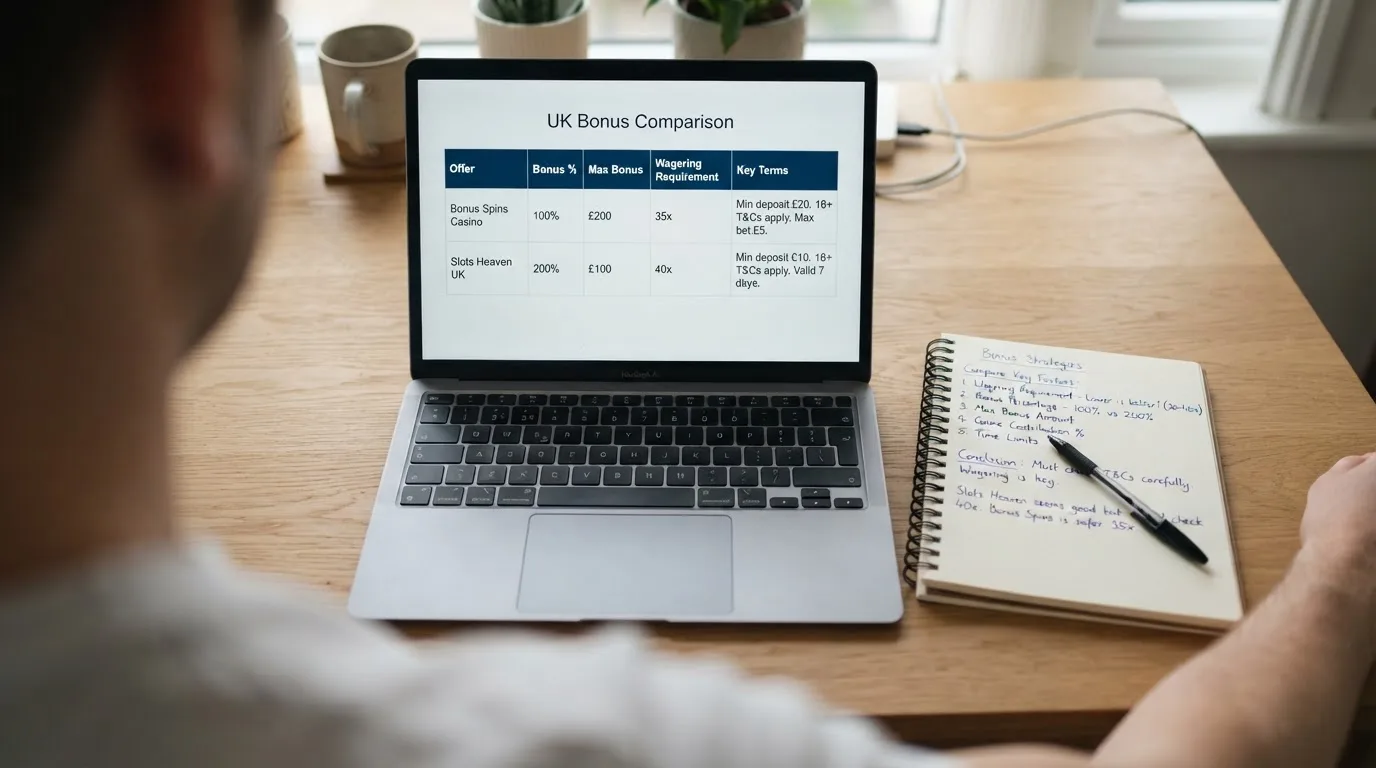
The second fundamental is that wagering applies to winnings, not to the spin value itself. The casino credits, say, ten spins at 10p each; the player logs in, plays the spins, lands something; the winnings sit in the bonus balance at, say, £4.20; the wagering requirement is 10x that £4.20, which is £42 of turnover before any of it becomes withdrawable cash. That is the formula a UK reader needs in their head before they take any daily offer, because it is the only number that explains how much real money the offer actually puts on the table.
The third fundamental is the slot the offer pins the spins to. Daily free spins almost never run on the casino’s full catalogue — they are tied to one named slot, and that slot is usually chosen because it has a high house edge or because the casino has a margin deal on it. A player who likes the named slot reads the offer as a genuine free chance on a game they would have played anyway; a player who does not like the slot reads the offer as a chore. The Commission’s rules do not constrain which slot a casino picks, and a daily-spins reader should expect the named slot to rotate, sometimes weekly.
The fourth fundamental is the timing. A daily free spins offer credits once per twenty-four-hour period, usually on login. A player who logs in twice in one day does not get twice the offer; the casino resets the credit window at a fixed time and the second login is just a second visit. A player who misses a day loses that day’s credit; there is no carry-over. A player who wants the offer reliably should log in at the same time each day, and a player who cannot commit to that habit will read the offer as far less generous than the marketing page suggests.
The legal frame: what the Gambling Commission actually requires
The Gambling Commission is sponsored by the Department for Culture, Media and Sport and operates under the Gambling Act 2005, which covers Great Britain — England, Scotland and Wales — and not Northern Ireland. Since the Gambling (Licensing and Advertising) Act 2014 any operator taking customers in Great Britain needs a Commission licence wherever it is based; a Curaçao, Maltese or Gibraltar operating licence is not a substitute. The two are not interchangeable: a brand that holds a Gibraltar remote licence but no UKGC licence cannot legally serve a player sitting in Bradford, and the licence number on the footer of the website is the only test that settles the question.
The register is the whole proof. The Commission’s public register of gambling businesses can be searched online and downloaded in full as a CSV or Excel file; on 18 September 2026 the register’s domain list held 1,065 active and 361 white-label domain entries. A white-label site trades under another company’s licence, which is why two storefronts — Coral and Ladbrokes are the example on this page — can share a single licence number: they are two product surfaces of one licensed operator. A remote casino licence number on the register has the form account-R-number-suffix, where the leading six digits repeat the licence holder’s account number and the “R” marks a remote, online licence. The 139 active remote casino operating licences on the register on 18 September 2026 are the universe the ten brands on this list are drawn from.
The minimum age at any licensed site is 18, and name, address and date of birth are verified before the first deposit or any play. That verification has been a hard rule since 7 May 2019, which is why a licensed UK casino cannot run an anonymous-play product even if it wanted to. The verification step is also the reason a daily free spins offer is gated behind a logged-in, identified account: the casino has to know who is logging in before it can credit the bonus, and the bonus is the casino’s way of keeping an identified player active.
Two stake tiers apply to online slots. For players aged 25 and over the maximum stake per game cycle is £5, in force from 9 April 2025; for 18-to-24-year-olds the maximum is £2, in force from 21 May 2025. The rule is per spin, and the lower age tier is the one that catches most of the daily-spins audience, because the typical daily-spins reader skews younger than the average slot player. A 19-year-old reader is looking at a £2 maximum stake on every slot the casino runs, including the slot the daily spins are pinned to, which is one of the reasons the slot choice matters so much.
There is no state-set deposit or loss ceiling at a UK-licensed casino, and that is a deliberate Commission choice. Operators must prompt a customer to set a financial limit before the first deposit, in force from 31 October 2025; the casino cannot let the player skip the prompt, and the limit the player sets is the player’s own choice. Since 31 October 2021 auto-play is banned at UK-licensed slots, a slot spin may not be faster than 2.5 seconds, and losses disguised as wins are banned — a slot may not show a “you won £3” banner on a spin that mathematically lost money. For a daily-spins reader those three rules reshape the slot itself: every daily spin is a manual press, takes at least 2.5 seconds, and never tells the player they won when they did not.
The player-protection machinery is GAMSTOP. GAMSTOP is the national online self-exclusion scheme, and it is a mandatory condition of every online licence since 31 March 2020. A player can self-exclude for six months, one year or five years, and the exclusion cannot be cancelled early; once it is in place, every UK-licensed casino is required to refuse to take the player’s deposits and to close the player’s account. A daily free spins offer is not a way around a GAMSTOP exclusion: the casino checks the register before it credits any bonus, and the bonus is blocked at the same point a deposit would be. The other national help routes are GamCare’s National Gambling Helpline and GambleAware, and both are signposted from every licensed casino’s responsible-gaming page.
Financial vulnerability checks run at £150 net deposits in a rolling 30 days, in force from 28 February 2025, using public data only. The wider financial risk assessments have been announced but are not yet in force; they are a future tightening, not a current rule. The £150 threshold is the point at which a licensed casino is required to run a check on the player, and the check is the reason a player who has been depositing and withdrawing steadily will sometimes be asked questions about their source of funds.
The payments and bonuses frame closes the picture. Credit cards are banned for gambling at any UK-licensed site since 14 April 2020, including credit cards routed through e-wallets; a casino cashier that lets the player deposit on credit is, by definition, not running under a UKGC licence. Since 19 December 2025 wagering requirements are capped at 10x, and mixed-product bonuses — bet on sport, get casino spins — are banned. The 10x cap is the ceiling on the daily free spins offer this page is built around, and the ban on mixed-product bonuses is the reason a daily spins offer now stands alone rather than being unlocked by a sports bet.
Offshore, the picture is one-sided. Providing gambling to people in Great Britain without a UKGC licence is an offence under section 33 of the Gambling Act 2005, and the Commission disrupts illegal sites through cease-and-desist notices, search-engine delisting, and payment and hosting referrals; it has no ISP-blocking power, so a determined player can still find an unlicensed site, but the casino itself is breaking the law by serving that player. No penalty is aimed at the player; what the player loses on an unlicensed site is protection — no GAMSTOP integration, no Commission complaints route, no approved ADR. For a daily-spins reader that is the practical cost of going offshore: the bonus might be larger, but the Commission cannot help when the casino refuses to pay out.
On tax, players pay no tax on gambling winnings in the UK; operators pay Remote Gaming Duty, which is being raised from 21% to 40% from 1 April 2026. The 40% rate is the model only — operators do the sums, players do not need to file anything — but it is the reason some offers on this page may tighten over the next year, because the operator’s underlying duty has just gone up by almost a factor of two.
What a 10x wagering requirement actually costs a player
The wagering-turnover calculation that drives every daily free spins offer is the most important number on the page, and the Commission’s 10x cap is what every licensed casino now has to work inside. The shape is the same on every offer: required turnover equals the bonus winnings multiplied by the wagering factor, and the time it takes to clear that turnover is what the player actually pays in time and expected loss. The calculation below is built around a representative UK offer — ten free spins at 10p per spin, winnings of £4.20, a 10x wagering requirement, and a stake of £1 per spin during the wagering phase — to show how the numbers line up under the rule.
The turnover required is £4.20 multiplied by 10, which is £42.00 of betting through the bonus balance before any of it becomes withdrawable cash. The number of spins that represents depends on the stake the player chooses to run at during wagering: at £1 a spin the £42 of turnover is 42 spins, at 50p a spin it is 84 spins, at 20p a spin it is 210 spins. The Commission’s 2.5-second minimum interval between spins is the speed limit: 42 spins at 2.5 seconds is 105 seconds, or just under two minutes; 210 spins is eight minutes and 45 seconds. None of those times are the binding cost — the binding cost is what the wagering itself does to the bonus balance as it plays out.
At an RTP of, say, 96% on the wagering slot, every £1 of turnover returns 96p on average and costs the player 4p. The £42 of turnover at 96% RTP has an expected loss of £1.68 — that is the price the player pays to convert the £4.20 of bonus winnings into withdrawable cash, in statistical average over many spins. A 94% RTP slot runs the same calculation at a £2.52 expected loss; a 98% RTP slot at £0.84. The slot the casino chooses for wagering is the single biggest determinant of what the offer costs the player in real money, and that is the reason a daily-spins reader should look at the wagering slot before they look at the headline spin count.
The honest band, then, looks like this: under the 10x cap, with a representative daily offer landing £4.20 in winnings, the player is looking at £42 of turnover, somewhere between one and nine minutes of spin time depending on stake size, and an expected loss somewhere between roughly £0.85 and £2.50 depending on the slot. That is the cost band the 10x cap produces, and it is the band every licensed UK daily free spins offer now sits inside. An offer outside that band — wagering above 10x, conversion caps that swallow the winnings, slots chosen for their house edge rather than their RTP — is an offer from a site without a UKGC licence, and the cost band above is what the player gives up by going there.
The calculation is a statistical estimate, not a guaranteed outcome for any individual player. It averages over many spins under the stated assumptions, and it promises no win, no payout and no return.
Responsible gaming at a UK free daily spins site
The responsible-gaming frame at a UK-licensed casino is built into the licence itself; it is not an optional page on the website. Every online licence has carried a GAMSTOP condition since 31 March 2020, and the casino cannot take a self-excluded player’s deposit, let alone credit a daily spins bonus to that player’s account. The 31 October 2025 rule that operators must prompt a customer to set a financial limit before the first deposit is the second pillar: a daily-spins reader who has never deposited will never have set that limit, because the rule only fires at the first deposit. The first time the player tries to deposit — to clear wagering, to play anything outside the daily offer — the casino will block the deposit until a limit is set.
For a player who only plays the daily free spins and never deposits, the limit-setting prompt will not fire. The offer is, by design, a way to keep a player logged in without requiring a deposit. The GAMSTOP machinery still runs in the background, and the casino still verifies identity before any bonus is credited, but the deposit-limit prompt is dormant. That is the shape of the offer as the Commission has framed it: a no-deposit bonus under tight wagering rules, on a fully identified account, integrated with the same self-exclusion register as every other licensed product.
The wider help routes are GamCare’s National Gambling Helpline and GambleAware. Both are signposted from every licensed casino’s responsible-gaming page, and a daily-spins reader who feels the offer is pulling them toward a deposit they did not plan has the same routes to call as any other player. The financial vulnerability check at £150 net deposits in a rolling 30 days — in force from 28 February 2025 — is the third backstop, and it is the one a player who escalates from daily spins into regular deposits will meet first.
The offshore picture is the contrast that makes the responsible-gaming frame legible. A site without a UKGC licence has no GAMSTOP integration, no Commission complaints route, and no approved ADR. The player can self-exclude, but the casino is not required to honour it; the player can complain, but the Commission cannot hear the complaint; the player can ask for an ADR ruling, but there is no ADR to ask. The cost of an unlicensed daily free spins offer is not just a worse wagering cap — it is the loss of every protection the Commission has built into the licensed offer.
Frequently asked questions
How do daily free spins without a deposit actually work?
A daily free spins offer at a UK-licensed casino credits a small number of spins — usually five to twenty — to the player’s account once every twenty-four hours, typically on login. The spins are tied to one named slot at a fixed stake, and the winnings land in the bonus balance rather than as cash. The player logs in, plays the spins, and either leaves the winnings in the bonus balance or works through the wagering requirement to convert them.
Do daily free spins come with wagering requirements at UK casinos?
Yes. Since 19 December 2025 the Gambling Commission has capped wagering requirements at 10x for any bonus a UK-licensed casino runs, and that cap covers daily free spins. The wagering applies to the winnings, not to the value of the spins themselves, and the casino usually sets a maximum conversion amount on top. A casino offering daily spins with no wagering at all is, in practice, an unusually generous offer rather than the licensed norm.
Are daily free spins offers only for new players?
No. A daily free spins offer by definition credits every day once the player logs in, which is a retention mechanic rather than a sign-up mechanic. New-player offers are usually a separate, larger one-off package that runs alongside the daily credit. A player who has been at the casino for months is still in line for the daily credit; the offer is not a once-per-account gift.
Which UK-licensed casinos offer daily free spins?
The Gambling Commission’s public register listed 139 businesses holding an active remote casino operating licence on 18 September 2026, and a subset of those run daily free spins offers. The ten brands covered on this page — Coral, Midnite, 32Red, BetVictor, MrQ, William Hill, PokerStars, Betfred, Grosvenor Casinos and Ladbrokes — are all on the register as active domains of their respective licence accounts, and the register is the test of whether a brand can run a UK daily free spins offer at all.
Is there a cap on winnings from daily free spins?
Most UK-licensed casinos set a maximum conversion amount on daily free spins winnings, on top of the 10x wagering cap. The conversion cap is the casino’s own choice rather than a Commission rule, and it is the line that decides how much of the bonus balance can ever become withdrawable cash. A reader who ignores the conversion cap will read the offer as far more generous than it is in practice.
Does a UK casino need a Gambling Commission licence to offer daily free spins?
Yes. Under the Gambling Act 2005 and the Gambling (Licensing and Advertising) Act 2014, any operator taking customers in Great Britain needs a Gambling Commission licence. A Curaçao, Maltese or Gibraltar operating licence is not a substitute, and an unlicensed casino offering daily free spins to a UK player is breaking section 33 of the Act. The licence is also the only proof that the offer runs under the 10x wagering cap, the GAMSTOP integration, and the player-protection machinery the Commission requires.