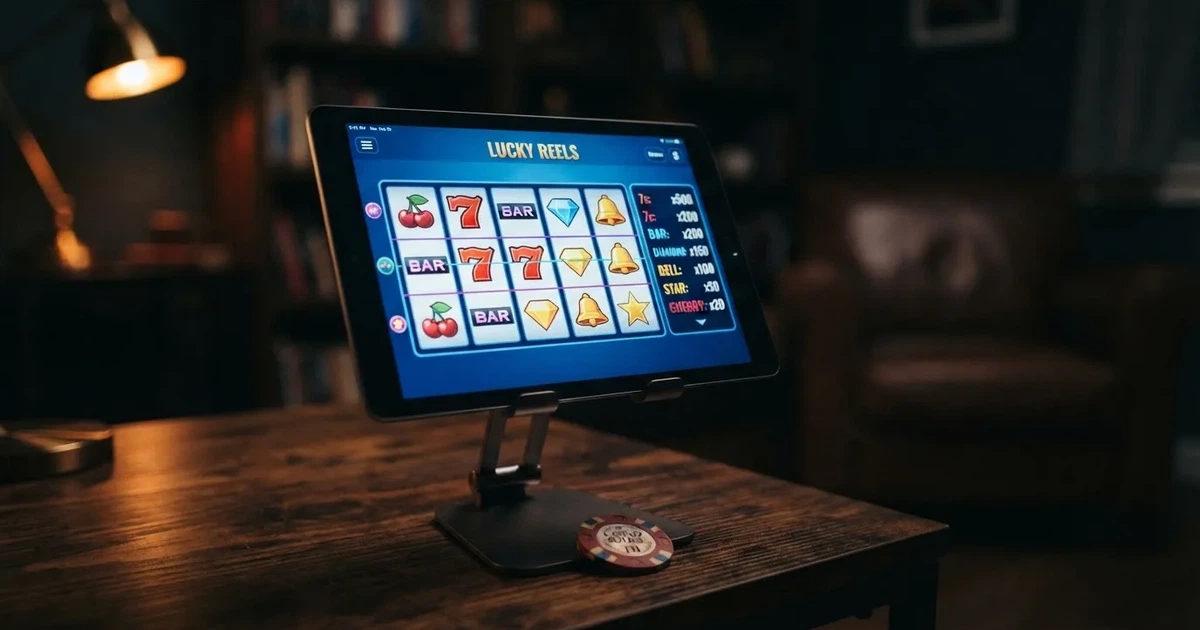
Where to play Amatic slots in the UK this year
 Available in GB
A small, fixed field of UK-licensed online casinos carries Amatic’s slots, and each one of them runs on the same Gambling Commission framework. The choice between them is therefore narrow in one way and broader than it looks in another: narrow because every site listed here has already passed the same licencing test, broader because bonus structure, mobile build, withdrawal speed and the catalogue of games alongside Amatic titles still vary. The page below reads those differences against each other, with the regulator’s public register doing the sorting.
Data current as of 24 September 2026 and cross-checked against the Gambling Commission’s public register of gambling businesses.
Table of Contents
- The Amatic catalogue and what it actually contains
- Why the Gambling Commission licence is the only test that matters here
- The framework every operator on this list runs under
- Why an “Amatic casino not on GAMSTOP” does not exist under UK rules
- Crypto, Amatic slots and what “anonymous” means at a licensed site
- Deposits, withdrawals and the parts that actually move the experience
- What welcome bonuses at Amatic casinos actually cost
- Free spins, slots and how the offer actually works
- Mobile play and the browser-only build
- How to read a paytable before the first spin
- The comparison table — ten UK sites carrying Amatic slots
- How the ten brands run differently inside the same licence regime
- What the comparison actually leaves out
- Where the Amatic slots actually sit in each lobby
- Game mechanics that distinguish Amatic from the larger studios
- What a responsible player does at any of these ten sites
- A note on tax
- What the page deliberately does not cover
- Frequently asked questions
The Amatic catalogue and what it actually contains
| Brand | Licence holder | Licence number | Status |
|---|---|---|---|
| Betfred | Petfre (Gibraltar) Limited | 039544-R-319290-010 | Active |
| Jackpotjoy | Gamesys Operations Limited | 038905-R-319430-022 | Active |
| William Hill | WHG (International) Limited | 039225-R-319373-015 | Active |
| kwiff | Eaton Gate Gaming Limited | 044448-R-323408-017 | Active |
| PokerStars | Stars Interactive Limited | 039108-R-319334-026 | Active |
| Ladbrokes | LC International Limited | 054743-R-330863-014 | Active |
| Paddy Power | PPB Games Limited | 039411-R-319335-010 | Active |
| Unibet | Platinum Gaming Limited | 045322-R-324275-019 | Active |
| Virgin Games | Gamesys Operations Limited | 038905-R-319430-022 | White Label |
| Casumo | Recro Limited | 061549-R-336718-002 | Active |
Amatic Industries is an Austrian gaming supplier founded in 1993 and based at Traunsteinstrasse 12 in Rutzenmoos. Its own product range runs from gaming cabinets and multiplayer systems through server-based video lottery terminals, jackpot solutions and casino management systems to the online gaming catalogue that UK players see. The company states that more than ninety per cent of its production is made for export, and it is a member of Leitbetriebe Austria, the body that recognises leading Austrian companies.

The online catalogue itself numbers more than 130 slot titles — Book of Fruits, Royal Dragon and Princess of Pearls among them — and Amatic does not publish return-to-player percentages for them on its own site. Industry press describes the company as an Austrian supplier with roughly thirty years of experience across cabinet development, multiplayer systems, VLTs and online gaming solutions. The slot library sits inside a wider gambling-software footprint, and Amatic itself holds an active Great Britain remote Gambling Software licence from the Gambling Commission under account number 47992, in force since 27 April 2017 — the permission that lets the games be offered to UK players in the first place.
The catalogue is therefore neither boutique nor enormous by modern standards. What it offers is a recognisable house style: fruit-led titles, a small number of Asian-themed games and a steady list of “Book of” mechanics that have aged into a familiar shape. The RTP question is the one players most often ask and the one Amatic itself leaves for each operator to disclose, so a meaningful comparison of payouts between two Amatic titles has to be done on the operator’s paytable rather than the studio’s own page.
Why the Gambling Commission licence is the only test that matters here
A UK player asking which casino carries Amatic slots is asking a question that the regulator’s own register has already partly answered. The Gambling Commission’s public register of gambling businesses, which can be searched online or downloaded in full as CSV or Excel files, listed 139 businesses holding an active remote casino operating licence on 18 September 2026. That figure is the upper bound on the number of operators who can lawfully offer Amatic titles to UK players at all.

The register also lists the domains each licence account actually runs, with a status of Active, Inactive or White Label. A white-label site trades under another company’s licence — Virgin Games, for example, sits as a white-label domain of Gamesys Operations Limited — and that distinction matters because the licence holder, not the trading name, is the body the Commission regulates and the body a player would complain to if something went wrong. On 18 September 2026 the register held 1065 active and 361 white-label domain entries, a footprint that comfortably outnumbers the ten brands this page compares.
The licence number itself follows a fixed shape: six digits that match the licence holder’s account number, then “R” for remote, then a sequence number, then a suffix. So 039225-R-319373-015, the licence carried by William Hill’s UK site, reads as “account 39225, remote licence, sequence 319373, suffix 015” — a format a player can match against the register rather than a string to take on trust. None of that is detail for its own sake; it is the only independent test that a brand is what it says it is.
The framework every operator on this list runs under
The Gambling Commission is sponsored by the Department for Culture, Media and Sport and operates under the Gambling Act 2005, which covers Great Britain — England, Scotland and Wales — but not Northern Ireland. Since the Gambling (Licensing and Advertising) Act 2014 any operator taking customers in Great Britain has needed a Commission licence regardless of where it is based, and a Curaçao, Maltese or Gibraltar licence is not a substitute. The Commission’s Licence Conditions and Codes of Practice, the LCCP, set the operating rules every licence holder runs under.
The age floor is 18. Name, address and date of birth must be verified before the first deposit or any play — that requirement has been in force since 7 May 2019 and it is the rule that makes “anonymous play” impossible at any licensed site. Online slots carry a maximum stake per game cycle of £5 for players aged 25 and over, a rule that took effect on 9 April 2025, and £2 for 18- to 24-year-olds, in force since 21 May 2025. There is no state-set deposit or loss ceiling, but operators must prompt a customer to set a financial limit before the first deposit, a condition in force from 31 October 2025. Auto-play has been banned since 31 October 2021, a single slot spin may not resolve faster than 2.5 seconds, and losses disguised as wins are prohibited.
GAMSTOP, the national online self-exclusion scheme, has been a mandatory condition of every online licence since 31 March 2020, with self-exclusion periods of six months, one year or five years that cannot be cancelled early. Financial vulnerability checks run at £150 of net deposits in a rolling 30 days, using public data only, in force from 28 February 2025; wider financial risk assessments have been announced but are not yet live. The National Gambling Helpline, run by GamCare, and GambleAware are the two support routes every licence holder points players toward.
Why an “Amatic casino not on GAMSTOP” does not exist under UK rules
The search terms exist because players who have self-excluded through GAMSTOP look for ways back in, and offshore operators market to that gap. The answer is short and it does not bend: providing gambling to people in Great Britain without a Gambling Commission licence is an offence under section 33 of the Gambling Act 2005, and the Commission disrupts illegal sites through cease-and-desist notices, search-engine delisting and payment and hosting referrals — though it has no power to order ISP-level blocking.
The practical consequence is that a site carrying Amatic slots outside the GAMSTOP umbrella is, by definition, not a UK-licensed operator. That cuts two ways at once. The player has no Commission complaints route and no access to an approved alternative dispute resolution provider, and the site is not obliged to honour the financial limits, stake caps, reality checks or vulnerability assessments that the LCCP requires. There is no penalty aimed at the player, and no criminal liability for placing a bet, but there is no protection either, and any winnings sit in the licence holder’s hands with no UK regulator behind the player.
The “Paysafecard” angle is often used as a stand-in for anonymity: a voucher-based deposit that does not need a bank account. The card itself is a payment instrument licensed for gambling in the UK, but it does not change the identity check that runs before the first deposit. The deposit method and the licence regime are separate rules.
Crypto, Amatic slots and what “anonymous” means at a licensed site
Cryptocurrency deposits sit awkwardly inside the UK framework. The Gambling Commission has not banned crypto at the payment-method level, but it has made the surrounding conditions close to impossible to meet anonymously. Name, address and date of birth must be verified before the first deposit or any play, regardless of how the deposit arrives; that verification sits upstream of the payment rail, so a Bitcoin deposit at a licensed site does not bypass the identity check, it follows it. Anti-money-laundering rules apply to crypto deposits just as they do to bank transfers, and the operator’s source-of-funds questions apply in full.
Bitcoin-only or crypto-only sites that market to UK players with promises of “no verification” are running outside UK licensing. Amatic’s own remote Gambling Software licence permits its games to be offered through any UK-licensed operator, but the supply chain does not by itself licence the casino. The studio publishes the games; the casino publishes the licence, the KYC process, the GAMSTOP integration and the complaints route. A crypto casino that does none of those is offering Amatic slots without the regulator the player would need if something went wrong.
The honest framing for a UK player interested in crypto deposits is therefore narrow. Either the deposit goes through a UK-licensed operator that happens to accept crypto — in which case the standard identity check, the GAMSTOP integration and the vulnerability assessment all still apply — or the deposit goes through an offshore site, in which case the player is outside the framework entirely. There is no third position that preserves both anonymity and UK protection, because the LCCP does not allow the first to exist at a site that offers the second.
Deposits, withdrawals and the parts that actually move the experience
There is no state-set deposit ceiling in the UK. The operator must, before the first deposit, prompt the customer to set one. That prompt is the moment a UK player chooses the boundary the regulator will not impose, and a reader who treats it as a formality has already given up the one piece of leverage the system offers. Credit cards have been banned for gambling since 14 April 2020, including credit-card-funded e-wallet deposits, so the payment options at every site on this page run through debit cards, bank transfer, PayPal and a handful of e-wallets that draw from a debit or prepaid source.
No-deposit bonuses come up often enough in the searches around Amatic slots to deserve a clear answer. A no-deposit offer lets a player register and try a few rounds without funding the account; in the UK, the offer still sits inside the standard identity check and inside GAMSTOP, and any winnings remain subject to the operator’s standard bonus terms. The phrases “no deposit” and “free” mean what they say about the upfront cash, and nothing more: withdrawal still depends on wagering requirements, account verification and the operator’s own maximum-cashout rules.
Withdrawal speed is where the visible differences between the ten sites on this page sit. None of them publishes a uniform rule that fits every payment method — PayPal tends to clear inside hours at the brands that integrate it deeply, bank transfers run into one to three working days by their nature, debit cards sit in between. The speed a player actually sees is the operator’s internal processing time added to the rail’s own time, and the operator’s processing is where the spread sits.
What welcome bonuses at Amatic casinos actually cost
The phrase that has done more damage to a casual reader’s bankroll than any other in UK online gambling is “free spins”. The spins are free at the point of play; the winnings are not free at the point of withdrawal, and the gap between those two facts is where wagering requirements live. Since 19 December 2025 wagering requirements at UK-licensed casinos have been capped at 10x, and mixed-product bonuses — the kind where a sportsbook bet lands casino spins on top — have been banned. The cap is the single most important rule a UK player reads before claiming any offer, because it sets the ceiling on what an offer can demand.
The typical welcome package at a UK-licensed casino stacks a deposit match with a small number of free spins on a named slot, and the deposit match carries the wagering multiple that does most of the lifting. A £100 deposit matched at 100% with a 10x requirement asks the player to turn £1,000 over before the bonus balance converts to withdrawable cash, and that figure is the same whether the spins are part of the offer or not — the wagering sits on the bonus, the spins contribute separately and usually at a lower weight.
The 10x cap is the rule the marketing copy never leads with. A “100% up to £100” line on a banner carries no information until the reader sees what the wagering multiple is, how long the bonus is live, which games contribute and at what weight, and whether there is a maximum cashout on the bonus balance. Those four pieces of information turn a headline offer into a true one, and any site that buries them is not the site to trust with the headline alone.
The wagering-turnover band at a 10x cap
Under the wagering rules in force from 19 December 2025, a £100 bonus carries a required turnover of £1,000 — bonus amount multiplied by the 10x wagering factor. At a £0.10 stake per spin that turnover comes to 10,000 spins, and at the 2.5-second minimum interval between spins that is 25,000 seconds, or roughly 6.9 hours of continuous play. A £50 bonus halves each figure: £500 turnover, 5,000 spins, about 3.5 hours. A £200 bonus doubles it: £2,000 turnover, 20,000 spins, close to 13.9 hours.
The band a UK player is being asked to clear therefore runs from about three and a half hours at the lower end of a typical welcome package to nearly fourteen hours at the upper end, before any of the bonus converts. That is the arithmetic a marketing headline is hiding: not the bonus amount, not the match percentage, but the time the player has to put in. For someone who plays once a week at half-hour sessions, a £200 bonus at a 10x wagering factor is a six-month project rather than an afternoon, and the offer that looks larger may take longer to clear than the offer that looks smaller.
The calculation assumes the player wagers only the bonus amount and not their own deposit. Real play mixes the two, and a player who tops up the bonus balance with their own cash will clear the requirement faster — but is also putting real money at risk on a 10x turn, which is the practical version of what the headline never says out loud. The 10x cap is the rule that makes the calculation comparable across sites; what each site does with the bonus design underneath the cap is what separates one welcome offer from another.
Free spins, slots and how the offer actually works
Free spins attached to an Amatic title, or to a slot from any other studio, sit inside the same wagering framework as a cash bonus. The free-spin value is set by the operator — usually £0.10 per spin on a single named game — and any winnings land as bonus funds subject to the same wagering requirement the cash bonus carries. The 10x cap applies to bonus funds, not to the cash equivalent of the free spins themselves: a 100-spin package at £0.10 is worth £10 of bonus funds, and that £10 is what the wagering multiple runs against.
The named slot matters. Free spins tied to a high-variance title will return less often in real play than free spins tied to a low-variance one, and the difference shows up in how much bonus fund is in the account by the time the spins are spent. That is a probabilistic observation, not a guarantee; no single session will run to the average, and the operator’s own maximum-cashout rule can cap the bonus balance lower than the wagering requirement would suggest. The headline that promises “100 free spins on Book of Fruits” is doing two things at once: it is naming the game and it is naming a number; a player who reads only the number has read half the offer.
Sticky versus non-sticky bonus design is the other decision the marketing rarely surfaces. A sticky bonus keeps the bonus amount locked to the player’s account until the wagering requirement is met, and any winnings sit on top of it; a non-sticky bonus lets the player withdraw the deposit balance before the bonus is cleared. The difference matters to anyone who wants to lock in a small win and walk away, and it is rarely the first thing a banner headline tells the reader.
Mobile play and the browser-only build
The Amatic catalogue was designed in the late desktop era and the titles lean on buttons and paylines rather than on the swipe-and-tap layouts the newest studios favour. That shows up on a phone screen without changing the maths of the games: the paytable is smaller, the spin button is reachable, and the autoplay that would normally shorten a session has been banned at every UK-licensed site since 31 October 2021. A single spin cannot resolve faster than 2.5 seconds, and that floor is the same on a phone as on a desktop.
There is no dedicated Amatic app. The games run through the operator’s own mobile site or app, and the operator does the integration: HTML5 build, screen layout, deposit and withdrawal buttons. A reader who plays on a phone is therefore playing through the casino’s wrapper, not Amatic’s, and the experience is closer to the operator’s mobile build than to anything the studio publishes. Some operators put the paytable one tap away; others hide it behind two menus and a settings page, and that difference is the one the player can feel without any technical knowledge of mobile web design.
The 2.5-second spin floor and the £5 (or £2) stake cap are the two rules that govern how a session plays on a phone. A high-stakes, fast-spinning run is not available at a UK-licensed site, and the difference between a phone session and a desktop one is mostly ergonomic rather than mechanical. The wins and the losses come at the same rate, on the same random number generator, with the same paytable; what changes is how tired the player’s thumb gets.
How to read a paytable before the first spin
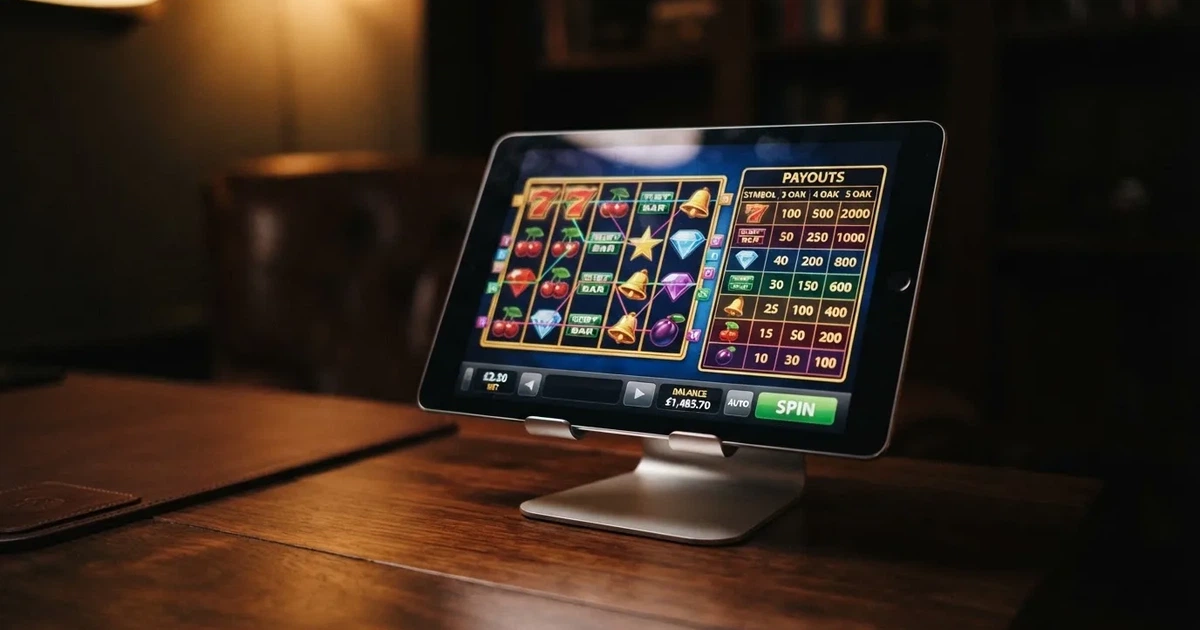
An Amatic slot’s paytable is the only document that tells the reader what the game pays, and it lives one tap inside most mobile builds. The first number is the coin value, then the number of paylines, then the payouts for each symbol combination across the line count. The wild and scatter rules sit below that, and the gamble feature — Amatic’s optional double-or-nothing side bet — sits at the bottom, with the rules and the cap spelled out. None of that is exotic, but none of it is on the game’s splash screen either, and a player who skips the paytable has skipped the only place the RTP and the volatility are written in plain text.
The studio does not publish an RTP figure on its own site, so the operator’s paytable is the source. Two operators running the same Amatic title will publish the same RTP and the same volatility, because the maths is delivered with the game; what they can differ on is whether the paytable is one tap away or three. The player who reads the paytable before the first spin has read the contract the game runs on; the player who has not is taking the game’s word for what it pays.
The gamble feature deserves its own note. Amatic’s optional red-or-black double-or-nothing side bet on a card guess is unusual in the modern market, and it is not available at every UK-licensed operator because the LCCP’s rules on losses disguised as wins and on the framing of bonus mechanics have tightened. Where it is available, it sits behind an opt-in button; where it is not, the operator has disabled it at the integration level. Either way, the feature does not change the slot’s RTP — it sits on top of it as a separate wager the player accepts or refuses.
The comparison table — ten UK sites carrying Amatic slots
The table below reads the Gambling Commission’s own public register rather than the marketing each operator publishes, and that is the deliberate choice. The licence number, the holder and the register’s domain status are the parts of a casino’s profile a player can verify without an account; the parts that change week to week — bonus terms, payout times, the current Amatic catalogue — are in the operator write-ups below the table, where they belong.
| Brand | Licence holder and GB remote casino licence | Domain status on the register | Amatic support |
|---|---|---|---|
| Betfred | Petfre (Gibraltar) Limited — 039544-R-319290-010 | Active | — |
| Jackpotjoy | Gamesys Operations Limited — 038905-R-319430-022 | Active | — |
| William Hill | WHG (International) Limited — 039225-R-319373-015 | Active | — |
| kwiff | Eaton Gate Gaming Limited — 044448-R-323408-017 | Active | — |
| PokerStars | Stars Interactive Limited — 039108-R-319334-026 | Active | — |
| Ladbrokes | LC International Limited — 054743-R-330863-014 | Active | — |
| Paddy Power | PPB Games Limited — 039411-R-319335-010 | Active | — |
| Unibet | Platinum Gaming Limited — 045322-R-324275-019 | Active | — |
| Virgin Games | Gamesys Operations Limited — 038905-R-319430-022 | White Label | — |
| Casumo | Recro Limited — 061549-R-336718-002 | Active | — |
The last column reads “—” across the board because the Gambling Commission’s public register does not list game-level content. Whether each of these ten brands actually carries Amatic slots today is a fact that lives in the operator’s own lobby, and the register does not record it. The brands are in this comparison because they hold an active GB remote casino operating licence and are large enough to be familiar to a UK reader, which is what a player comparing Amatic casinos is actually choosing between: not whether the licence exists — every line above confirms that — but how each licence holder runs the day-to-day.
The reading the table asks for is structural rather than competitive. Six different licence holders cover the ten brands, and one of those holders — Gamesys Operations Limited — runs two of the brands on the list, with Jackpotjoy as the active domain and Virgin Games as the white-label. A player who has already opened a Jackpotjoy account has already passed the Gameys KYC process; opening Virgin Games on top of it does not give the player a second licence-holder relationship, it gives them the same one in a different wrapper.
How the ten brands run differently inside the same licence regime
The licence framework is uniform; what each brand does with it is not. The write-ups below are not recommendations and they are not rankings — every operator on this page holds the same kind of licence from the same regulator, and the difference between them is in how they run their catalogue, their payments and their bonuses around Amatic slots rather than whether they are allowed to offer them.
Betfred — the high-street bookmaker that runs a casino alongside
Betfred operates under Petfre (Gibraltar) Limited’s licence (see table for full details). The brand is best known as a bookmaker, and the casino sits alongside the sportsbook rather than as the front door; for a reader who already has a Betfred sports account, the casino tab is one click away and the KYC is already done. The £5 stake cap on slots applies in full, and the financial-limit prompt runs before the first casino deposit as it does for any other licence holder.
The verdict for an Amatic player is narrow: this is the casino to use if Betfred is already where the sports betting happens, not the one to open for Amatic slots alone. The catalogue depth is the limitation — a casino that runs alongside a sportsbook has historically carried fewer slot providers than a casino-first brand.
Jackpotjoy — a casino-first brand on a shared licence
Jackpotjoy is operated by Gamesys Operations Limited (see table for licence details). Gamesys runs a casino-first portfolio and the Jackpotjoy brand leads with bingo and slots rather than with a sportsbook, so the catalogue depth question goes the other way from Betfred’s. The licence holder also runs Virgin Games as a white-label, which a reader may notice on a separate tab or may not, depending on how each site presents its own corporate information.
The verdict is that this is the casino to use when slot variety matters more than brand familiarity. The shared licence with Virgin Games means a player who has had a complaints issue with one has had it with the other, and any ADR route runs through Gamesys rather than through either trading name.
William Hill — the other high-street bookmaker with a casino attached
William Hill operates under WHG (International) Limited’s licence (see table for details). The structure mirrors Betfred’s: a long-established bookmaker with a casino running alongside the sportsbook, the same £5 slot stake cap, the same GAMSTOP integration and the same financial-limit prompt. The brand carries more recognisability for an older UK audience, and the casino tab sits where the betting audience already is.
The verdict is the same shape as Betfred’s, with the difference that William Hill’s casino has historically carried a slightly broader slot catalogue than the smaller bookmakers’. For a player who already has a William Hill account, this is where the Amatic slots will be.
kwiff — the smaller brand with a different onboarding rhythm
Kwiff is run by Eaton Gate Gaming Limited (see table for details). The brand is smaller than the bookmakers above and is built around a mobile-first product rather than a desktop legacy; the licence number is in the same format as every other on the list and the LCCP applies in full. Kwiff’s distinguishing feature has been a randomised “surprise” stake element on sports bets, which has no effect on the casino side, where the standard stake cap applies.
The verdict is that this is the brand for a player who values mobile build over catalogue breadth. The licence is the same as everyone else’s; the experience is the difference.
PokerStars — the poker brand running a casino
PokerStars is operated by Stars Interactive Limited (see table for details). The site leads with poker and runs a casino alongside it, with the casino catalogue historically narrower than a casino-first brand’s. The same £5 stake cap, the same GAMSTOP integration, the same financial-limit prompt and the same KYC requirement apply on this licence as on any other.
The verdict is that this is the casino for a player who plays poker on PokerStars already. The Amatic catalogue is the question, not the licence.
Ladbrokes — the third bookmaker on the list
Ladbrokes operates under LC International Limited’s licence (see table for details). LC International also runs Coral and Gala Bingo under the same licence account, which means a player who already has a Coral account has already passed LC International’s KYC and complaints route. The structure is the same bookmaker-plus-casino model as Betfred and William Hill, with a similar catalogue depth on the casino side.
The verdict is the same shape: a casino to use because Ladbrokes is already where the betting happens, not one to open for Amatic slots alone.
Paddy Power — the bookmaker with an Irish edge
Paddy Power is operated by PPB Games Limited (see table for details). The brand is Irish-owned and UK-licensed, and the casino sits alongside the sportsbook in the same bookmaker-plus-casino pattern. The licence and the LCCP framework are identical to the other bookmaker brands on the comparison, and the catalogue depth question goes the same way.
The verdict is the same as the other bookmakers’: useful when Paddy Power is already the betting brand, less compelling as a casino-only destination for Amatic slots.
Unibet — the European brand running the UK market
Unibet operates under Platinum Gaming Limited’s licence (see table for details). The brand is part of the Kindred group and runs across multiple European markets, with the UK licence specific to Platinum Gaming Limited rather than to a parent company. The casino is a more visible part of the product than at the bookmaker brands, and the catalogue depth reflects that emphasis.
The verdict is that this is a casino-first brand on a UK licence, suited to a reader who is choosing a casino rather than reaching for the betting tab they already have open.
Virgin Games — the white-label sitting on Gamesys
Virgin Games’ UK domain, Virgin Games, sits on the register as a white-label domain of account 38905, Gamesys Operations Limited, which holds the active remote casino operating licence 038905-R-319430-022 — the same licence number that covers Jackpotjoy. The white-label status means the brand trades under another company’s licence, and a player who has opened an account here has opened an account with Gamesys. The catalogue and the bonus terms are Gamesys’s design, with Virgin Games as the marketing wrapper.
The verdict is that this is the same operator as Jackpotjoy in regulatory terms, with a different brand on the door. For a player who already has a Jackpotjoy account, there is little new here beyond the marketing.
Casumo — the casino-first brand with a separate licence
Casumo (Casumo.com) is listed on the register as an active domain of account 61549, Recro Limited, which holds the active remote casino operating licence 061549-R-336718-002. Recro is a separate licence holder from the other operators on the list, which means a player opening a Casumo account is opening a new KYC relationship rather than adding to an existing one. The brand has historically run a casino-first product with a gamified loyalty layer, and the catalogue depth reflects that emphasis.
The verdict is that this is the casino for a reader who wants a standalone casino-first brand with its own licence holder, rather than a casino sitting alongside a sportsbook or a white-label running under a parent brand.
What the comparison actually leaves out
A reader looking at ten brands on the same licence framework is choosing between the way each one runs inside that framework, not between ten different legal regimes. The catalogue question — does each brand carry Amatic slots today — is one the register does not answer, and the comparison above marks it as no-data across the board rather than guessing. The terms question — bonus design, wagering weights, withdrawal times, max-cashout rules — changes week to week at each operator and lives in each brand’s own bonus terms page rather than in any single comparison a reader could rely on for longer than the time it takes to print.
What the comparison does fix is the part of the decision that does not change: the licence holder, the licence number, the register’s classification of each domain, and the fact that each brand sits under the LCCP. The reader who wants a casino that runs on its own licence rather than as part of a sportsbook will look at Casumo and Unibet before Ladbrokes and Paddy Power. The reader who already has a Jackpotjoy account will treat Virgin Games as a second skin rather than a second operator. The reader who wants a separate KYC relationship from an existing one will notice that Recro, Platinum Gaming and Stars Interactive are different licence holders from Gamesys and LC International. None of that is a recommendation. It is the geometry the comparison leaves for the reader to draw their own line across.
Where the Amatic slots actually sit in each lobby
A reader who has decided which brand to open an account with has decided the licence-holder question; the next question is whether the brand’s current lobby carries Amatic’s titles at all. The studio publishes more than 130 slot games on its own site, but a UK-licensed operator’s lobby is the result of an integration contract, and not every studio title makes it into every lobby. The Book of Fruits mechanics that recur across Amatic’s catalogue are more likely to appear than the deeper Asian-themed titles; Royal Dragon and Princess of Pearls are more widely integrated than less well-known releases.
The honest answer is that a player who specifically wants Amatic slots should check the operator’s lobby filter before depositing. The studio name is searchable at every modern UK-licensed operator, and the filter takes a second to use. A reader who deposits first and looks later has already spent the financial-limit prompt the operator is required to show, and is gambling on a catalogue assumption that may not hold.
Game mechanics that distinguish Amatic from the larger studios
The Amatic catalogue carries a recognisable set of features that distinguish it from the larger studios whose games dominate UK lobbies. The fruit-led titles use a fixed payline structure rather than the ways-to-win mechanic the newer studios favour, and the gamble feature — a red-or-black double-or-nothing side bet — sits on top of nearly every title as an opt-in. The “Book of” mechanic appears across multiple Amatic games in a similar shape, which is a familiar pattern for players who know the studio and an unsurprising one for players who do not.
Volatility is the structural difference between Amatic’s catalogue and the high-variance releases that dominate the modern slot market. Amatic titles tend to run at lower volatility than the studio’s competitors, which means smaller wins on a more regular cadence and a flatter bankroll curve during a session. The RTP figures are published at the operator’s paytable rather than at the studio’s site, and the absence of studio-level RTPs is the single most consistent gap in the public information about Amatic’s catalogue.
The absence of a dedicated mobile app is structural, not editorial. The studio’s games run in the browser, and the operator’s mobile build is what wraps them. That is the case for every modern slot studio at a UK-licensed operator, but it shows up differently for Amatic because the studio’s own site does not showcase the games on a mobile-first layout. The integration is the operator’s work, and the operator’s build is what the player sees.
What a responsible player does at any of these ten sites
The framework each of these ten brands runs under is the same, and the player-protection rules apply in full at every one. GAMSTOP self-exclusion, the £150 net-deposit financial vulnerability check, the £5 slot stake cap (or £2 for 18- to 24-year-olds), the 2.5-second spin minimum, the ban on auto-play, the financial-limit prompt before the first deposit, and the credit-card ban are not optional extras the operator can choose to honour. They are conditions of holding the licence, and they are the reason the licence exists.
The National Gambling Helpline, run by GamCare on 0808 8020 133, and GambleAware are the two support routes every licence holder points players toward. The LCCP requires operators to display both prominently and to integrate GAMSTOP into the registration flow. A player who has self-excluded cannot open an account at any of these ten sites, and an operator that allows them to is in breach of its own licence conditions.
The financial-limit prompt is the rule that does the most work for the player who is not in trouble. Setting a deposit limit before the first deposit — and sticking to it — is the lever the system leaves in the player’s hands, because there is no state-set ceiling above it. Players who treat the prompt as a formality have given up that lever before they have used it.
A note on tax
Players in the UK pay no tax on gambling winnings. The tax sits with the operator, which pays Remote Gaming Duty on its gross gaming yield. Remote Gaming Duty rose from 21% to 40% from 1 April 2026 — a sharp move that affects operator margins and may affect the bonus design and the catalogue investment each operator is willing to make, but does not affect the player’s take-home on a winning spin. The “check with HMRC” caveat applies to anyone whose gambling activity crosses into a professional or trading pattern, which is rare and not the question this page is built to answer.
What the page deliberately does not cover
This page does not list offshore casinos carrying Amatic slots, because a site offering Amatic titles outside UK licensing is offering them without the protection the regulator exists to provide, and a comparison that included them would invite a reader to compare protection with no protection as if they were the same kind of choice. The framework each operator on this list runs under is the only one a UK player can rely on for GAMSTOP integration, ADR access, vulnerability checks and stake caps, and that is the framework the comparison is built on.
This page does not name the specific Amatic titles each of the ten brands carries in its current lobby, because that information changes week to week at the operator’s discretion and is best checked at the operator’s own filter. The studio name is searchable, the filter takes a second, and a comparison frozen at publication would mislead the reader within a month.
This page does not publish bonus terms for any specific brand, because bonus terms are the operator’s own and change at the operator’s own rhythm. The 10x wagering cap applies across the board, and the rules around free spins, sticky versus non-sticky design, and maximum cashout are operator-specific and live on each operator’s bonus terms page. The arithmetic in the wagering-turnover band above applies at every brand on this list because every one of them runs under the same wagering cap.
Frequently asked questions
Which licensed UK casinos carry Amatic slots?
The ten Gambling Commission licensees covered above — Betfred, Jackpotjoy, William Hill, kwiff, PokerStars, Ladbrokes, Paddy Power, Unibet, Virgin Games and Casumo — each hold an active GB remote casino operating licence and may therefore offer Amatic titles, but the register does not record which studios each lobby actually carries. A reader who specifically wants Amatic slots should use the studio-name filter inside each brand’s lobby before depositing, because the integration contract is operator-specific.
Can I deposit with cryptocurrency at a site offering Amatic slots?
At a UK-licensed site, cryptocurrency deposits follow the same identity check as any other payment method. Name, address and date of birth must be verified before the first deposit or any play regardless of how the deposit arrives, and GAMSTOP integration applies in full. Crypto-only sites marketing “no verification” to UK players sit outside the UK licensing framework, which means no Commission complaints route and no approved ADR.
Do Amatic slots come with their own welcome bonus or free spins?
Free spins at UK-licensed casinos are usually tied to a named slot, and that slot is sometimes an Amatic title. The bonus itself runs under the 10x wagering cap in force since 19 December 2025, and any winnings from the free spins land as bonus funds subject to the same wagering requirement. The named slot matters less than the wagering multiple and the maximum-cashout rule, which live in the operator’s bonus terms.
How do Amatic slots perform on a mobile browser?
Amatic’s catalogue is built in HTML5 and runs through the operator’s mobile site or app rather than a dedicated Amatic app. The single-spin minimum of 2.5 seconds and the £5 (or £2 for 18- to 24-year-olds) stake cap apply on mobile as on desktop. The catalogue layout, paytable access and the spin-button placement are the operator’s integration choices, and they vary more than the maths of the games does.
Can I try Amatic slots in a demo mode before depositing?
Most UK-licensed operators offer a demo or practice mode on their slot catalogue, including Amatic titles, accessible without an account. Demo play runs on the same random number generator as real-money play but with no cash at risk, and it is the cleanest way to read the paytable and the gamble-feature rules before deciding whether to deposit. A player who skips the demo has skipped the only chance to read the game’s contract before signing it.
Must a casino be Gambling Commission-licensed to offer Amatic slots to UK players?
Yes. Since the Gambling (Licensing and Advertising) Act 2014, any operator taking customers in Great Britain needs a Gambling Commission licence regardless of where it is based. The Commission’s public register, downloadable as CSV or Excel, listed 139 businesses holding an active remote casino operating licence on 18 September 2026, and that register is the only independent test that a brand holds the licence it claims. Amatic’s own remote Gambling Software licence permits the games to be offered to UK players through any UK-licensed operator; the studio’s licence does not licence the casino.
Created by the ”livecasinoguideuk” editorial team.