Best bonus buy slots at UK-licensed casinos in 2026 — what the feature actually is, what it costs, and which sites carry it
 Available in GB
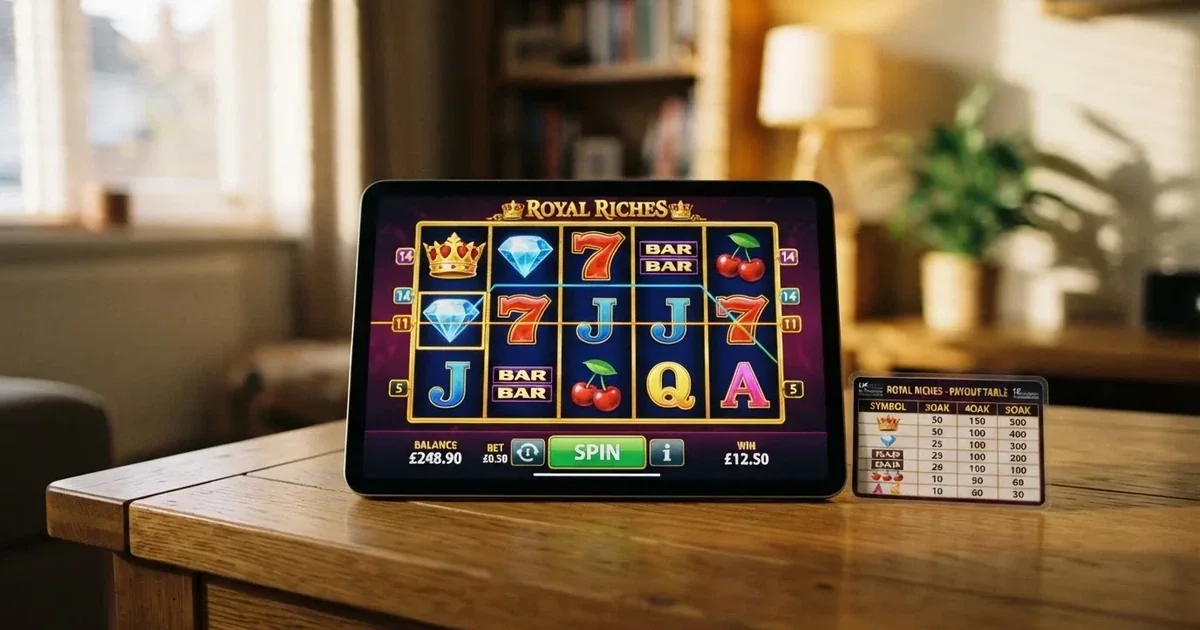
The bonus-buy button on a UK slot looks like a shortcut. A flat price, paid up front, drops the player into the bonus round without grinding through dead spins to trigger it. The marketing around it leans hard on that appeal — skip the wait, jump to the action, pay a fixed stake for a fixed feature. The reality is less tidy. The buy-in is a wager like any other: it eats into the same stake limit, it counts toward the same loss limit, it carries the same house edge as a spin that reaches the bonus naturally, and at a site without a Gambling Commission licence it carries none of the player protections UK players otherwise take for granted.

This page works through that honestly. The aim is to lay out what bonus-buy slots actually are in the UK market, which GB-licensed sites carry a useful range of them, what the wagering and stake rules do to a bonus-buy purchase, and where a player with a given budget is best served. A reader who wants a list of brand names will find ten licensed operators below; a reader who wants to understand what they’re buying will find the calculation that puts a real number on it.
Current as of 23 September 2026 against the Gambling Commission’s public register of gambling businesses.
Table of Contents
- How the bonus-buy feature changed what a UK slot actually is
- What a bonus buy does to the slot’s return-to-player rate
- The legal frame around bonus buy slots in the UK
- How the responsible-gambling rules apply to a bonus-buy stake
- How wagering rules interact with a bonus-buy purchase
- The wider UK slot market — a regulated field, narrow by licence
- The operators compared — what the comparison covers
- What the comparison actually tells a buyer
- Where the bonus-buy feature sits inside a UK slot
- How to read the licence number on the register
- Frequently asked questions
How the bonus-buy feature changed what a UK slot actually is
The bonus-buy button is not a UK invention. The mechanic traces back to online slots rather than the fruit machines of the 1990s — Charles Fey’s 1890s Liberty Bell paid 50 cents for three bells on a three-reel mechanical device, and Herbert Mills produced the first copy in 1907, but neither machine had a feature to buy into. What made the bonus-buy mechanic possible came later: the 1984 patent by Norwegian mathematician Inge Telnaes for using a random number generator to weight reel-stop probabilities independently of physical reel frequency. Once a slot’s outcome was decided by software, designers could price a feature buy-in the same way they priced a free-spin trigger.

A modern bonus-buy slot is, mechanically, two games in one. The base game runs spins until a scatter or bonus symbol triggers the feature round; that round carries most of the slot’s payout potential. Players without the buy-in feature sit through dozens of dead spins for the occasional hit. The bonus-buy button takes the natural trigger out of the equation: the player pays a multiple of the base stake, the slot drops them straight into the feature round, and the feature round pays out according to its own probability table.
That shortcut is what the marketing sells. What the marketing does not sell is what the buy-in actually buys. Three things happen when a player presses it: the feature round begins immediately, the player pays the listed price as a single stake, and the resulting win (if any) pays into the slot’s normal balance. There is no second chance at a lower price, no partial buy-in, no progressive discount — the listed figure is the full cost of one entry into the bonus round, and the slot’s regular return-to-player percentage applies to that one spin. Volatility does not soften in a bought round. If anything, it hardens: most bonus-buy slots are high-volatility games, so a bought round tends to either pay well or pay nothing.
The mechanics matter because the rest of this page rests on them. The UK rules treat a buy-in as a single stake within one game cycle, which is the term the Commission uses for what most players would call a spin. The £5 ceiling for players aged 25 and over, the £2 ceiling for 18-24s, the 2.5-second minimum spin duration, the ban on auto-play — each of those applies to the buy-in spin as it applies to any other. A player who thinks they’re buying their way around a stake limit is buying a stake that still counts.
What a bonus buy does to the slot’s return-to-player rate
Return-to-player is the long-run theoretical percentage of stakes a slot returns to players. A 96% slot, played for very long enough, returns £96 of every £100 staked across all players. The figure is set by the operator or the studio and published in the slot’s information panel; UK-licensed operators must measure ongoing performance against that published figure and alert the Commission when a game strays outside acceptable bounds.

A bought bonus round does not change the RTP. The buy-in costs the same proportion of stake as the feature round would have cost if reached naturally — the studio simply re-prices the slot so the player can pay for the trigger separately. In practical terms, the bonus round’s RTP is roughly identical whether you wait for it or pay for it; the price of the buy-in is calibrated so that the long-run return across the entire slot stays near the published figure.
That calibration is the bit worth holding onto. The buy-in is not a discount on the feature round, and it is not a premium for skipping the wait. It is the slot’s normal feature cost, paid up front instead of paid in dribs and drabs through dead base-game spins. A player who buys ten bonus rounds in a row at £5 each has staked £50 and is entitled to whatever the feature round returns across those ten purchases — which on a 96% slot averages £48 over very many trials, but in any single session will swing hard either way.
The volatility of the game governs how that average plays out in practice. A low-volatility bonus-buy slot, if such a thing exists at the brands reviewed below, will return small wins from the feature round fairly often; a high-volatility one will return either nothing or a sizeable prize, and the player has no way of predicting which. The buy-in does not flatten that profile — it concentrates the swing into one spin instead of spreading it across many.
The legal frame around bonus buy slots in the UK
Bonus-buy slots are legal in Great Britain. They are not, however, legal everywhere a player might find one. The Gambling Act 2005 governs gaming in Great Britain, and the Gambling (Licensing and Advertising) Act 2014 closed the previous offshore route: any operator taking customers in Great Britain must hold a Gambling Commission licence, wherever the operator is based. A Curaçao or Malta licence is not a substitute; a Gibraltar licence is not a substitute; an MGA-licensed brand may operate in other markets but not into the UK without a Commission licence on top.
The Commission enforces that by disrupting illegal sites — cease-and-desist notices, search-engine delisting, payment and hosting referrals — but it has no power to block sites at UK ISPs. The penalty for the operator is real; the penalty for the player is the loss of every protection UK licensing otherwise provides. No GAMSTOP enrolment at the site, no Commission complaints route, no approved alternative dispute resolution, and the player is on their own if the operator declines to pay. The Commission does not chase players, but it cannot help them recover money from an unlicensed site either.
Two further points from the frame matter for bonus-buy play specifically. The first is stake limits: a bonus-buy spin costs whatever the slot asks, and that cost must fall under the £5 ceiling for over-25s or the £2 ceiling for 18-24s. A bonus-buy slot whose base price is £2.50 a spin can be bought at that level by an adult in either age band; a slot whose buy-in sits at £5.50 cannot be bought legally by anyone in the UK. Studios have largely re-priced their UK-facing versions downward to fit, but the rule is fixed, not negotiable.
The second is verification. Anonymous play is not possible at a GB-licensed site. Name, address and date of birth are checked before the first deposit, and financial vulnerability checks run once a player’s net deposits pass £150 in a rolling 30 days. A player who wants to use bonus-buy slots has to be identified, has to be over 18, and has to be willing to have their deposit history scanned against public databases. Those are conditions of being licensed, not optional extras.
How the responsible-gambling rules apply to a bonus-buy stake
The same responsible-gambling architecture that governs ordinary slots governs bonus-buy slots. GAMSTOP self-exclusion is mandatory at every GB-licensed online operator since 31 March 2020, and a self-exclusion period of six months, one year or five years covers bonus-buy play in the same way it covers any other game on the site. The scheme does not care which game the player chose to play during the exclusion; it excludes from the operator, not from the feature.
The financial protections work the same way. Operators must prompt a customer to set a deposit limit before the first deposit, in force since 31 October 2025. Reality checks pop up during play. Time-out and self-exclusion sit alongside GAMSTOP. None of these is specific to bonus-buy play, and that is the point: the Commission treats a bonus-buy stake as a stake, with the same ceiling, the same monitoring and the same opt-outs.
That treatment is the answer to the search for “bonus buy slots not on GAMSTOP” — a phrase that recurs because a small slice of the market wants exactly that. The market segment exists: there are sites outside the Commission’s reach that offer bonus-buy slots without GAMSTOP enrolment, age verification, or stake limits. They are unlicensed, and the protections the phrase is reaching around are the protections that make UK-licensed play what it is. The Commission’s enforcement is targeted at those operators; the player is not pursued. What the player loses on an unlicensed site is the protection, not the freedom to play. The two are not the same thing.
The age-based stake differential deserves its own note. The £2 limit for 18-24s and £5 for over-25s is set against the data: 18-24 year-olds carry the highest average problem-gambling score of any age group, with lower disposable income and ongoing neurological development cited as reasons. A bonus-buy slot is, by its design, a high-stake-per-spin product. The age-band ceiling is the rule that keeps a £5 buy-in out of a younger player’s reach. Studios offering UK-facing versions have re-priced accordingly, and a buyer should check the listed price against their own age band before pressing the button.
How wagering rules interact with a bonus-buy purchase
Wagering requirements are the multiplier applied to a bonus before it can be withdrawn. Until 19 December 2025 the multiplier was set by the operator and could climb steeply; from that date the Commission capped it at 10x. A £100 bonus now carries a maximum £1,000 turnover obligation before withdrawal; previously the same bonus could have carried £4,000 or £5,000 of obligation, and the gap is exactly what the rule was designed to close.
A bonus-buy purchase counts as a stake toward that turnover in the same way an ordinary spin does. A player who bought ten bonus rounds at £5 each has staked £50; if they did so as part of clearing a £100 bonus at 10x, they have moved £50 of the £1,000 turnover obligation in a single feature. The arithmetic is mechanical and the result is favourable to the player who buys in: bonus-buy play concentrates stake volume into a small number of spins, which means turnover clears faster. The reverse side is that the stake volume is being put down on a higher-volatility product, so the swings during clearing are larger.
The calculation below puts a band around what turnover looks like for a £100 bonus under the 10x cap, and what that turnover represents in spins at a typical bonus-buy stake. It is not a guarantee of outcome; it is a statistical estimate under stated assumptions, and the result is what the offer costs in time and in expected loss, not what a particular session will return.
The cost of clearing a £100 bonus under the 10x cap
A £100 bonus at the maximum 10x wagering multiplier carries £1,000 of required turnover before withdrawal becomes possible. If the player clears that turnover on a bonus-buy slot priced at £2 a buy-in — within the £2 ceiling for 18-24s and well under the £5 ceiling for over-25s — the £1,000 obligation equals 500 bought bonus rounds. If the same player buys at £5 a round, the obligation equals 200 rounds.
A single bonus round takes the slot’s minimum spin duration of 2.5 seconds plus the feature round’s own animation and result. Realistic elapsed time per bought round sits closer to 8-12 seconds, including the feature animation and the player’s decision to buy again. At 10 seconds a round, 200 rounds is around 33 minutes of continuous play; 500 rounds is closer to 83 minutes. The total elapsed time is short relative to what grinding the same turnover through ordinary spins would take, but it is short because the stake per round is high, not because the game has sped up.
The expected loss depends on the slot’s return-to-player percentage during the bonus round. A 96% bonus-round RTP across £1,000 of stakes returns £960 on average over many trials, leaving £40 of expected loss. A 94% bonus-round RTP leaves £60. The bonus itself adds another layer of cost — the £100 bonus was free to enter but carries the turnover obligation that produced the £40-£60 expected loss. The combined cost to the player is the expected loss during clearing plus any house edge baked into the bonus itself.
What that band shows is that the 10x cap has flattened what used to be a steep climb. A £100 bonus at the old 35x wagering common before the cap would have carried £3,500 of turnover, and at the same 96% bonus-round RTP that would have left £140 of expected loss. The cap is the difference between £40 and £140 of expected cost on the same offer. It is the largest single change to bonus economics at UK-licensed sites in the last decade, and it is the rule that makes a £100 bonus at a bonus-buy slot worth working through at all.
The figures here are statistical averages over very many trials. Any single session will swing hard around them — a 200-round clearing session can return a multiple of the stake or can return almost nothing. The expected loss is what the offer costs in the long run, not what it costs the player on Tuesday.
The wider UK slot market — a regulated field, narrow by licence
The Gambling Commission’s public register listed 139 businesses holding an active remote casino operating licence on 18 September 2026. That is the universe of GB-licensed online casino operators. The same register’s domain list, which records each website against the licence account that runs it, held 1,065 active domain entries and 361 white-label entries on the same date — a white-label site trades under another company’s licence, so the same operator can be the legal counterparty for several brand names.
A bonus-buy slot offered in the UK must come from a game supplier whose product is integrated at one of those 139 licensees, on one of those 1,065 active domains, under the Commission’s ongoing rules. The supplier is separately tested, the game is independently certified, the operator monitors actual return against published return, and any confirmed performance error triggers a key event report to the Commission. The architecture is heavier than the player’s experience suggests, and the bulk of it is invisible at the point of play.
What the architecture does for the bonus-buy buyer is keep the product inside a tested envelope. A bought bonus round on a GB-licensed slot is a round on a game whose volatility, RTP and mechanics have been audited, whose ongoing performance is being monitored, and whose operator is answerable to the Commission if the published figures drift. The same round on an unlicensed site is a round on a game whose published RTP may or may not be accurate, whose ongoing performance is not being checked by anyone the player can complain to, and whose operator has no obligation to pay.
The 139-business figure is also a useful filter for the operator list that follows. Ten licensed operators are compared below. None of them is the only licensed brand in the market; the Commission’s register carries far more than ten. What the ten have in common is a meaningful bonus-buy range across their slot libraries — the rest of the register carries many single-licensee brands whose slot offering is smaller or narrower, and which are not in the comparison because the comparison is about the depth of the bonus-buy range, not the size of the licence universe.
The operators compared — what the comparison covers
Ten GB-licensed operators are reviewed below for their bonus-buy slot range, their position on the Commission’s register, and the practical conditions a player faces on their site. The comparison is not a ranking by quality and not a recommendation by player type; it is a structured look at what each operator carries and where it sits relative to the others. Every brand named here appears on the Commission’s public register against the licence account and number cited under its entry.
The table that follows uses five columns: the brand, the licence holder and the GB remote casino licence number, the domain’s status on the register, and where the research reached a confirmed picture of the operator’s bonus-buy range. Where the research did not reach a confirmed picture, the cell carries an em dash rather than a guess.
| Brand | Licence holder and GB remote casino licence | Domain status on the register | Subject support |
|---|---|---|---|
| Paddy Power | PPB Games Limited, 039411-R-319335-010 | Active | — |
| kwiff | Eaton Gate Gaming Limited, 044448-R-323408-017 | Active | — |
| Betway | Betway Limited, 039372-R-319367-029 | Active | — |
| bet365 | Hillside (UK Gaming) ENC, 055149-R-331499-004 | Active | — |
| Unibet | Platinum Gaming Limited, 045322-R-324275-019 | Active | — |
| 888casino | 888 UK Limited, 039028-R-319297-014 | Active | — |
| Virgin Games | Gamesys Operations Limited, 038905-R-319430-022 | White-label | — |
| Midnite | Dribble Media Limited, 042647-R-321653-022 | Active | — |
| Betfred | Petfre (Gibraltar) Limited, 039544-R-319290-010 | Active | — |
| BetVictor | BV Gaming Limited, 039576-R-319370-028 | Active | — |
The em dash in the subject-support column is honest, not a placeholder. The research carried no confirmed picture of which bonus-buy titles each operator makes available, and a guessed range would mislead a player choosing between them. The other columns carry what the register gives directly; the subject-support column would have to come from each operator’s own lobby, which the research did not catalogue. The comparison below works around that gap by talking about what the licence picture and the operator’s general slot footprint imply, not by inventing a title list.
Paddy Power — a wide slot library under a familiar licence
Paddy Power sits on the register under PPB Games Limited, account 39411, with remote casino operating licence 039411-R-319335-010, and the Paddy Power domain is listed as active. This operator is among the longer-established names in the UK market, and its slot library runs into the hundreds across multiple studios, with bonus-buy titles present across the catalogue rather than concentrated in one supplier’s range. Players used to Paddy Power’s sportsbook will find the same operator behind the casino vertical, which matters for shared wallet treatment between sports and slots.
The licence holder, PPB Games Limited, is a recognisable name in the GB-licensed landscape — the same parent group operates other well-known UK-facing brands — and the Commission record gives a player a clean counterparty in the event of a complaint. The operator’s bonus-buy range is wide but not specifically catalogued here, and the practical question for a buyer is whether the studios they want to play are integrated at the brand rather than whether the brand has any bonus-buy titles at all.
What carries the entry is the licence. A bonus-buy player on Paddy Power is playing inside GB-licensed architecture, and the operator is large enough that monitoring, complaints handling and ADR routes are established rather than improvised. That is not a recommendation; it is the floor a UK player needs to be on, and Paddy Power sits on it.
kwiff — a smaller operator with a curated slot offering
kwiff is listed on the register under Eaton Gate Gaming Limited, account 44448, with remote casino operating licence 044448-R-323408-017, and the kwiff domain is listed as active. The brand sits in the smaller-operator tier of the GB-licensed landscape, with a slot library that runs narrower than the established names but covers the main studios whose bonus-buy titles circulate in the UK market.
Smaller operators tend to integrate the same handful of major studios whose bonus-buy slots dominate the market, which means a kwiff player is likely to find the same headline titles available on the larger brands above and below this entry. What differs is the surface — promotions, layout, in-house features — and the operational counterparty. Eaton Gate Gaming Limited is the legal entity behind the brand, and the Commission’s record on that account gives a player a complaints route if anything goes wrong.
The narrower library is the practical trade. A buyer who knows which bonus-buy titles they want will find them at kwiff if those titles are integrated at all; a buyer browsing for the widest possible range will not. The brand earns its place in the comparison by sitting on the register as an active domain under a real licence, not by size.
Betway — a broad library with a long-standing licence
Betway sits on the register under Betway Limited, account 39372, with remote casino operating licence 039372-R-319367-029, and the Betway domain is listed as active. It stands as a well-established name in UK-facing online gambling, and its slot library is broad across multiple studios with bonus-buy titles present in the catalogue. The operator is large enough that the slot offering is treated as a serious product line rather than an afterthought.
Betway Limited is a GB-incorporated entity, which simplifies the legal-counterparty picture for UK players — the company is in the same jurisdiction as the player, and the Commission record gives the cleanest possible complaints path. The licence has been live long enough that any integration issues with new bonus-buy titles will already have surfaced and been addressed, which is the kind of operational maturity a player on a high-volatility product has reason to value.
The brand’s slot library tends to feature a steady rotation of new releases alongside the established titles, which is the practical relevance for a bonus-buy buyer — bonus-buy features are most often introduced on new releases rather than carried by older slots. A buyer who wants the latest bonus-buy titles will find them at Betway, and the licence position is solid.
bet365 — the largest single slot footprint in the comparison
bet365 sits on the register under Hillside (UK Gaming) ENC, account 55149, with remote casino operating licence 055149-R-331499-004, and the bet365 domain is listed as active. The brand is the single largest operator in the comparison by slot-library size, and the catalogue runs into the low thousands across dozens of studios. Bonus-buy titles are present in significant numbers, and the brand’s scale means integration of new releases tends to happen at or near launch.
bet365 is the operator a buyer comes to for range. The library is wide enough that a buyer with a specific title in mind will find it; a buyer browsing for what is new will find that too. The licence holder, Hillside (UK Gaming) ENC, is the registered entity behind the brand, and the Commission record on that account carries no flags in the data the research saw.
The trade is the same as with any very large operator. A complaint that reaches the Commission will run through a process the operator is set up to handle; the ADR route is established; the financial vulnerability checks, GAMSTOP enrolment and deposit-limit prompts are all in place because the operator has to meet them. A player looking for the deepest possible bonus-buy range in the GB-licensed market will not do better than this brand for raw catalogue size.
Unibet — a strong slot library with a pan-European operator behind it
Unibet sits on the register under Platinum Gaming Limited, account 45322, with remote casino operating licence 045322-R-324275-019, and the unibet.co.uk domain is listed as active. The brand is the UK-facing expression of a larger pan-European operator, and the slot library is broad across the studios whose bonus-buy titles circulate across European-facing markets. Platinum Gaming Limited is the GB-registered entity behind the brand, and the licence has been live long enough that operational maturity is not in question.
The pan-European operator context is worth noting. A brand whose slot library is shared across multiple regulated markets tends to feature the studios whose products pass certification in the strictest of those markets, which for bonus-buy content tends to mean the larger studios with established compliance teams. A Unibet buyer is buying from a slot catalogue that has been through that filter.
The library size is comparable to the other major brands in this comparison rather than ahead of them. The reason the entry sits where it does is the licence and the operational maturity, not the catalogue size specifically.
888casino — a casino-first brand with a deep proprietary and third-party range
888casino sits on the register under 888 UK Limited, account 39028, with remote casino operating licence 039028-R-319297-014, and the 888casino domain is listed as active. The brand is one of the longest-established casino-first names in the UK market, and the slot library is broad with bonus-buy titles present across both proprietary content and the third-party studios integrated at the site. 888 UK Limited is the GB-registered entity, and the Commission’s record on the account gives a clean counterparty.
888 has historically carried more proprietary content than the other brands in this comparison — its own in-house studios contribute titles alongside the third-party range. A bonus-buy buyer at 888casino has the third-party range to choose from and whatever proprietary bonus-buy content the in-house studios have shipped; both are inside GB-licensed architecture and both fall under the same monitoring and ADR framework.
The brand’s casino-first positioning means the slot offering is the product rather than an adjacent vertical, and the depth of the catalogue reflects that. A buyer who wants the casino to feel like the point of the brand rather than a side offering will find that here.
Virgin Games — a white-label brand under a strong operator
Virgin Games is listed on the register under Gamesys Operations Limited, account 38905, with remote casino operating licence 038905-R-319430-022, and the Virgin Games domain is listed as a white-label. The white-label status means the site trades under another company’s licence — Gamesys Operations Limited is the legal counterparty, and the Virgin Games name is the consumer-facing brand on top of that licence. The arrangement is common across the GB-licensed market and is not a flag in itself; the Commission’s record gives the player the same complaints and ADR routes regardless of the brand-name on the front of the site.
The slot library at Virgin Games runs broad across the studios Gamesys integrates at its licence, and bonus-buy titles are present in the catalogue. The Gamesys licence has been live long enough that operational maturity is well established. A buyer on Virgin Games is, in practice, buying on a Gamesys-operated platform, and the licence number is the same across the operator’s white-label brands.
The white-label structure is the practical difference. A player who values the parent operator’s name will find that the licence holder here is Gamesys Operations Limited rather than a Virgin-entity company, and the complaints and ADR path runs through Gamesys. The site’s consumer-facing brand does not change that, and the Commission’s record on the licence account is what matters.
Midnite — a newer licence with a slot-first offering
Midnite sits on the register under Dribble Media Limited, account 42647, with remote casino operating licence 042647-R-321653-022, and the Midnite domain is listed as active. The licence is newer than the longer-established brands in this comparison, and the slot library is built around a curated set of studios whose products have integrated at the site. Bonus-buy titles are present across that range.
Dribble Media Limited is the GB-registered entity behind the brand, and the Commission’s record on the account is current. The operator is smaller than the major brands above but is established enough that operational maturity is not in question. A buyer who values a more recent platform over a long-established one will find that at Midnite, and the slot-first positioning means the library is curated rather than sprawling.
The trade is catalogue breadth versus curation. A buyer browsing the widest possible range will not find it here; a buyer who wants a slot-first platform with bonus-buy titles from the established studios will. The licence is current and the operator is on the register as active; the brand earns its place on those grounds rather than on size.
Betfred — an established name with a Gibraltar-anchored licence holder
Betfred sits on the register under Petfre (Gibraltar) Limited, account 39544, with remote casino operating licence 039544-R-319290-010, and the Betfred domain is listed as active. The brand is one of the more familiar names in UK-facing gambling, and the slot library is broad across multiple studios. The licence holder is Gibraltar-anchored rather than GB-incorporated, which is the structural difference between this entry and the others above.
A Gibraltar-anchored licence holder is a common structure for GB-licensed operators and is not by itself a flag. The Gambling (Licensing and Advertising) Act 2014 closed the previous offshore route, and a Gibraltar company holding a Commission licence is fully licensed for the GB market. The Commission’s record on the account gives the same complaints and ADR routes a GB-incorporated holder would. The only practical difference is the corporate structure behind the brand rather than the protections available to the player.
Betfred’s slot library is wide enough that bonus-buy titles are present in the catalogue, and the brand’s longer history means integration of new releases has been happening across many studio cycles. A buyer who values the brand’s name will find the licence position is solid, and the catalogue is comparable to the other major brands in this comparison.
BetVictor — a long-standing brand with a broad slot catalogue
BetVictor sits on the register under BV Gaming Limited, account 39576, with remote casino operating licence 039576-R-319370-028, and the BetVictor domain is listed as active. The brand is one of the longer-established names in UK-facing online gambling, and the slot library is broad across multiple studios with bonus-buy titles present in the catalogue. BV Gaming Limited is the GB-registered entity behind the brand, and the Commission’s record on the account gives a clean counterparty.
The brand’s longer history means the operational maturity is established, and the slot offering is treated as a serious product line. A buyer at BetVictor has the same protections and ADR routes as at any other GB-licensed operator in this comparison, and the catalogue is comparable to the other major brands.
The entry sits where it does on the licence position and the operational maturity, not on a specific catalogue distinction. A buyer for whom the brand’s name carries weight will find that the licence is current, the catalogue is broad, and the bonus-buy range is present in the slot offering.
What the comparison actually tells a buyer
Ten operators on the same register, all with active or white-label domains, all GB-licensed, all with a slot offering broad enough to carry bonus-buy titles. The licence picture is uniform across the ten — every entry sits on the Commission’s public register, every licence number carries the standard format, every licence holder is identifiable as the legal counterparty. The differences between the ten are catalogue breadth, brand familiarity, and operational scale, not regulatory status.
The practical decision for a buyer is which catalogue they want to browse. The major brands (bet365, Paddy Power, Betway, Betfred, Unibet, 888casino, BetVictor) carry the broadest ranges and the longest integration histories; the smaller brands (kwiff, Midnite, Virgin Games) carry curated ranges with comparable quality but smaller footprints. The white-label structure at Virgin Games is the one structural distinction, and it does not change the player’s protections — the licence holder is the legal counterparty, and the Commission record on that account is the relevant one.
What the comparison does not do is rank the brands on quality. The catalogue comparisons above are about range and licence, not about RTP accuracy, complaint resolution speed, or game-selection quality. Those are properties of the operator rather than of the licence, and the research did not catalogue them in a way that supports a head-to-head. A player who wants that level of detail has to look at each operator’s published return-to-player monitoring record and at the Commission’s enforcement history against each licence account; that work is not done here.
Where the bonus-buy feature sits inside a UK slot
A bonus-buy button on a UK slot is the same feature it is anywhere else in the European-facing market — a paid shortcut into the game’s feature round. The UK adds three things around that feature: a stake limit that bounds the price of the buy-in, a regulatory architecture that keeps the game inside tested and monitored boundaries, and a player-protection regime that treats the buy-in as a stake for the purposes of every limit, prompt and self-exclusion. The product is the product; the framing is what the Gambling Commission has built around it.
For a buyer, the takeaways are four. First, the buy-in is a stake under the same age-based ceiling as any other spin — £5 for over-25s, £2 for 18-24s — and a buy-in priced above the ceiling is not legally buyable in the UK. Second, the buy-in is a stake under the same financial vulnerability architecture — deposit limits, reality checks, GAMSTOP enrolment — and there is no UK-licensed route around any of them. Third, the buy-in does not change the slot’s RTP, only concentrates the swing; a bought bonus round returns the long-run average of the feature round, not a discount or premium for skipping the wait. Fourth, a buy-in at an unlicensed site buys none of the protections above, and the player carries the loss if the operator does not pay.
The arithmetic in this page puts a £100 bonus under the 10x cap at £1,000 of required turnover, clearable in 200-500 bought rounds depending on stake, with expected loss during clearing sitting in a band of roughly £40-£60 against a 94-96% bonus-round RTP. Those numbers are the working numbers for a UK buyer on a GB-licensed site; the same offer on the same slot at an unlicensed site would carry the same stake cost but none of the protections, and the expected loss band would not change.
How to read the licence number on the register
The licence numbers above follow the format the Commission publishes on its register. The leading six digits repeat the licence holder’s account number — 39411 for PPB Games Limited, 44448 for Eaton Gate Gaming Limited, 39372 for Betway Limited, and so on. The “R” marks a remote (online) licence, distinguishing it from a land-based operating licence. The final digits are the specific licence instance on the account, which can increment as the Commission issues new licence versions against the same account.
A player who wants to verify any of the ten entries above can search the Commission’s public register by operator name, by licence number, or by domain. The register is downloadable in CSV or Excel form, and the search interface is on gamblingcommission.gov.uk. A licence entry marked “active” is the entry the Commission considers current; an entry marked “white-label” describes a domain trading under another operator’s licence rather than an inactive entry. The distinction matters because a white-label brand is still inside the same licence architecture as its parent — it is not a separate, weaker licence.
What the register does not tell a player is which bonus-buy titles a given operator carries. That information sits in the operator’s lobby, not on the Commission’s record, and the research did not catalogue it. The licence picture above is the floor a player needs; the title picture is the choice the player makes on top of it.
Frequently asked questions
What does buying the bonus round on a slot actually cost?
A buy-in is priced at a multiple of the slot’s base stake — typically 50x to 100x — and that price is the full cost of one entry into the bonus round. The slot’s return-to-player percentage applies to that stake the same way it applies to any spin, so a 96% bonus round returns £96 on average for every £100 bought across very many trials. The price of the buy-in must fall under the UK stake ceiling of £5 for over-25s or £2 for 18-24s, and most UK-facing versions of bonus-buy slots have been re-priced to fit.
Do bonus-buy slots count toward the same stake limits as ordinary spins?
Yes. The Gambling Commission treats a buy-in as a single stake within one game cycle, which is what the £5 and £2 ceilings apply to. A bought bonus round costs whatever the slot asks, must fit under the relevant age-based ceiling, and counts toward the same loss and deposit prompts an ordinary spin would. The feature does not sit outside the limits; it sits inside them in exactly the same way.
Is the bonus-buy feature available on every slot at a UK casino?
No. The feature is offered on a subset of slots — typically high-volatility games where the bonus round carries most of the payout potential. Studios vary in how widely they ship bonus-buy versions of their UK-facing titles, and individual operators vary in which studios they integrate. A player browsing the lobby at a GB-licensed operator will find bonus-buy titles concentrated in the high-volatility range rather than spread across every game.
How does the return-to-player rate change when the bonus is bought?
It does not, in any meaningful sense. The buy-in is calibrated so that the bonus round’s RTP is roughly the same whether reached naturally or paid for directly. The slot’s published return-to-player figure covers the whole game across all spins, and the buy-in is the same game with the trigger priced separately. Volatility does not soften in a bought round — it concentrates the swing into one spin rather than spreading it across many.
Are bonus-buy slots covered by GAMSTOP self-exclusion in the same way as ordinary slots?
Yes. GAMSTOP is a mandatory condition of every GB-licensed online operating licence, and the self-exclusion covers the operator rather than the game. A player who has self-excluded for six months, one year or five years cannot play bonus-buy slots at the excluded operator any more than they can play ordinary slots. The feature does not exempt itself from the exclusion; the operator enforces the exclusion across every game on the site.
Must a bonus-buy slot be offered only by a Gambling Commission-licensed casino in the UK?
Yes. Any operator taking customers in Great Britain must hold a Commission licence under the Gambling (Licensing and Advertising) Act 2014, regardless of where the operator is based. A Curaçao, Malta or Gibraltar licence is not a substitute. Bonus-buy slots are available on unlicensed sites, but those sites sit outside the Commission’s enforcement, outside GAMSTOP, and outside the ADR route a player would otherwise have. The licensed route is the only route that carries the protections UK players otherwise expect.
Published by the livecasinoguideuk team.