
Five-Reel slots in the UK: what they are, what they cost, and which sites carry them
 Available in GB
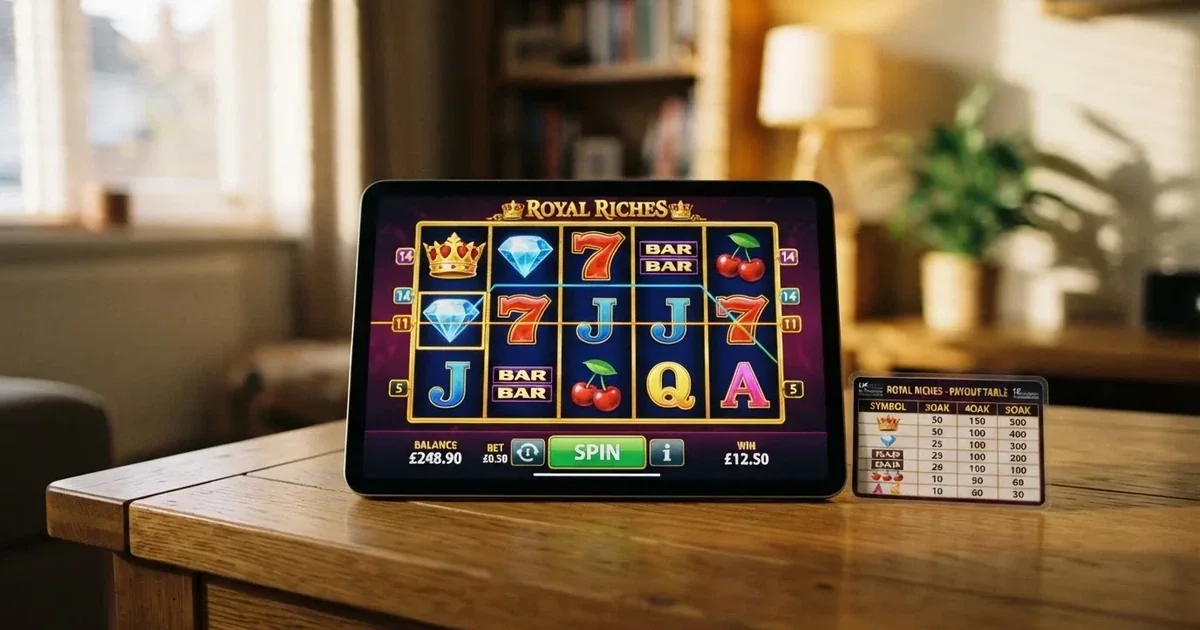
A five-reel slot is the standard shape of the modern video slot: five vertical columns of symbols, three to four rows each, and a fixed set of paylines or “ways” running across them. The format swallowed the older three-reel cabinet game decades ago and has stayed there because it can hold more symbols, more paylines and more bonus mechanics than a three-reel machine ever could. For UK players in 2026, the format is also the one every Gambling Commission licensee carries most heavily, and the one every safety rule from spin speed to stake cap is written against.
The information in this guide is current as of 23 September 2026 based on the Gambling Commission’s public register.
Table of Contents
- Free five-reel slots and the no-registration option
- Bonus features built into five-reel slots
- The paytable, paylines and how to read a five-reel slot’s rules
- A worked look at what a wagering bonus actually costs
- Reading the bonus terms on a five-reel slot promotion
- A note on the wider five-reel slot format
- Safer play on five-reel slots
- The UK market in 2026 — who is licensed, who runs what
- BetVictor at a glance
- Betfred at a glance
- Jackpotjoy at a glance
- William Hill at a glance
- kwiff at a glance
- PokerStars at a glance
- Ladbrokes at a glance
- Paddy Power at a glance
- Unibet at a glance
- Virgin Games at a glance
- Casumo at a glance
- How the licensed operators stack up
- Choosing a five-reel slot: the practical decision
- Five-reel slots and adjacent formats
- Frequently asked questions about five-reel slots in the UK
Free five-reel slots and the no-registration option
A “free” five-reel slot usually means one of three different things, and they are not interchangeable.

A demo version runs the full slot on a casino site without accepting real money — the player clicks “play for fun” or similar and the reels spin against a virtual balance. Demo play does not require an account at most GB-licensed operators: a player can open the game in a browser tab, watch the paytable, and spin without registering. This is the cleanest route for testing volatility and bonus frequency before committing.
A no-deposit bonus is something else: a small credit or batch of free spins the casino hands a new account holder on sign-up, without requiring a deposit first. It looks free, but it carries the same kind of wagering rules as a deposit offer, and the operator will not pay out winnings until those rules are met. A demo is open to anyone; a no-deposit bonus is a promotion tied to a registered, age-verified account.
A free-spins bonus round is built into the slot itself — landing three scatter symbols triggers ten, fifteen, twenty or more spins at the same stake. These are not a marketing gimmick; they are part of the game’s paytable, and on a real-money spin they pay in real money. Whether those winnings carry further wagering depends on the casino’s terms, not on the slot.
The distinction matters because a player searching for “free” play often wants the demo, lands on a no-deposit offer, and then wonders why the winnings cannot be withdrawn. The two exist for different reasons. The demo is a sales tool the operator uses to win trust; the no-deposit bonus is a marketing tool the operator uses to win sign-ups. Both are legitimate; neither is a free lunch.
Across the sites reviewed below, demo play is available on the bulk of the catalogue without an account. No-deposit offers come and go, and the section on bonuses walks through how to read them.
Bonus features built into five-reel slots
A five-reel slot without at least one bonus feature is unusual in 2026. The paytable’s main game is the spinning reels and the matching of symbols along a payline; everything else is layered on top.

Wild symbols substitute for other paying symbols (usually not the scatter) to complete a line. Some wilds are expanding — a wild that lands on reel three stretches to fill the whole reel. Some are sticky during free spins, locking in place for the rest of the round. A few carry a multiplier: a 2x wild doubles the line win when it is part of the match. The slot’s paytable spells out exactly what each wild does, because a wild’s behaviour is one of the things that separates two games with otherwise identical reels.
Scatter symbols typically trigger the free-spin round when three or more land anywhere on the reels, regardless of position. The scatter is also often the highest-paying single symbol in the base game.
Free-spin rounds are where most of the variance sits. A common structure: three scatters award ten spins; four award fifteen; five award twenty. During the round, wilds may stick, multipliers may climb, or a bonus symbol may unlock further spins. The free-spin round is also where the slot’s advertised “max win” usually lives — ten thousand times stake or more is not unusual in a bonus round, though it lands rarely.
Bonus-buy features let the player purchase the bonus round directly, skipping the base game. In the UK, bonus buys were restricted by the Gambling Commission; not every slot exposes them, and on those that do the cost is set at a multiple of the stake (commonly 50x to 100x). The price is on screen before the player confirms.
Cascading or tumbling reels replace winning symbols with new ones, letting a single spin produce multiple consecutive wins. Megaways is a licensed reel-layout system that varies the number of symbols per reel on every spin, producing thousands of ways to win; it is a separate engine bolted onto someone else’s theme, not a separate game studio. Progressive jackpots pool a fraction of every stake into a prize that grows until it is hit; on a five-reel slot this is usually a network jackpot shared across multiple operators.
Bonus features do not change the underlying return-to-player figure; they redistribute it. A slot with a heavy bonus round tends to spend more of its return in the bonus than in the base game, which is why a long base-game stretch of nothing is normal even on a high-RTP game. The arithmetic is in the section on what an offer costs.
The paytable, paylines and how to read a five-reel slot’s rules
The paytable is the contract between the slot and the player. It lists every symbol’s value, every wild’s behaviour, the cost of the bonus buy where one exists, and the rules of the free-spin round. It is also where the volatility and the RTP sit, and reading it before staking real money is the single habit that prevents most of the mistakes new players make on five-reel slots.
Paylines are the lines across the reels on which matching symbols pay. A classic five-reel slot has 20 to 25 fixed paylines; a “ways” slot — anything branded “243 ways” or “1,024 ways” — pays on every adjacent-symbol match regardless of line, which inflates the apparent hit rate without inflating the long-term return. The Megaways system goes further, varying the ways on every spin between roughly 100 and 117,000 depending on the symbol stack.
Reading the paytable for a five-reel slot means four things:
- The symbol values. The top symbol pays a multiple of stake for a five-of-a-kind match, often 20x to 50x for the base game’s premium symbols. Lower symbols pay less and match more often.
- The scatter and bonus trigger. Usually three scatters anywhere on the reels; the paytable states the exact count.
- The free-spin round’s rules. How many spins, what changes during them, whether extra spins can be retriggered.
- The RTP and volatility. Stated as a percentage (the long-term theoretical return) and a class (low, medium, high, or “very high”). The volatility is descriptive, not a promise, but it does tell the player whether to expect regular small wins or rare large ones.
A slot’s volatility describes its risk profile in plain language: a low-volatility slot pays smaller wins more regularly, a high-volatility slot pays fewer but bigger wins. The figure shapes how a bankroll survives a session, and it is the thing a paytable review will state before anything else.
A worked look at what a wagering bonus actually costs
The arithmetic that decides whether a bonus is worth taking is the wagering requirement. Since 19 December 2025, UK wagering requirements are capped at 10x on any promotional bonus — the highest the regulator permits. Stated as a band rather than a single figure, because the inputs vary and the conclusion follows them.
Take a £100 deposit match with a 10x wagering requirement on the bonus: the player must turn over £1,000 before withdrawing bonus-derived winnings. At a £1 stake per spin, that is 1,000 spins. At the UK minimum spin interval of 2.5 seconds, 1,000 spins take 2,500 seconds — roughly 42 minutes of continuous play. A £10 stake per spin drops the time to about four minutes; a 10p stake stretches it to roughly seven hours. The stake size alone changes the time to clear by a factor of one hundred, which is why “10x wagering” is a ceiling on the multiplier, not a measure of how long the bonus takes.
What it costs the player is a different question, and it depends on the slot’s RTP. A 96% RTP slot returns £96 for every £100 turned over in the long run, so the expected loss on the £1,000 turnover is roughly £40 — the price of clearing the bonus. On a 94% RTP slot the expected loss is closer to £60. The arithmetic is the same shape for a no-deposit free-spins offer: count the wagering multiple, multiply by the bonus value, and apply the slot’s house edge to find what the round costs on average.
The arithmetic assumes only the bonus amount is wagered, not any deposited cash on top of it, and it assumes the slot’s RTP holds in the long run rather than over any single session. The number is an estimate, not a guarantee: a single session can land anywhere on the distribution, and a player who clears the wagering requirement quickly can come out ahead on a high-volatility slot, while a player who grinds for hours on a low-volatility game can come out behind. The house always has an edge, and on a bonus the edge shows up as the gap between the turnover and what the maths returns.
The figure to carry away: a 10x wagering cap means the worst case is ten times the bonus in required play. Any offer advertised above that figure in the UK market is either from an unlicensed operator or carries terms that the headline number does not describe.
Reading the bonus terms on a five-reel slot promotion
Three terms appear in nearly every UK slot promotion, and each one can change the arithmetic in the section above.
Game weighting restricts the RTP contribution of different slots to the wagering requirement. A typical weighting gives 100% to most slots, 50% to table games, and 0% to a small list of exclusions. On a slot restricted to 50% weighting, the £1,000 of required turnover effectively becomes £2,000 of slot play. The promotion looks the same; the cost roughly doubles.
Maximum bet during wagering caps the stake per spin while the bonus is active — often £2 or £5. A player who ignores this and stakes higher voids the bonus and any winnings. The cap exists because a high-stake spin could clear the wagering requirement in a single spin and turn the bonus into an arbitrage, which is not what the operator is selling.
Maximum cashout from bonus winnings caps what a player can withdraw from a bonus-derived balance. On a no-deposit free-spins offer this is often £100 or less, and the slot’s bonus round can land above it. The cap means the bonus’s upside is bounded as well as its downside.
A player reading only the headline — “£100 bonus, 10x wagering” — misses the weighting, the bet cap and the cashout cap. All three appear in the promotion’s full terms, and the difference between a fair offer and a punishing one usually sits in those paragraphs.
A note on the wider five-reel slot format
The five-reel slot did not arrive fully formed. Charles Fey of San Francisco built the first automatic slot machine — the three-reel Liberty Bell — with symbols of horseshoes, diamonds, spades, hearts and a bell; it paid ten nickels (50 cents) for three aligned bell symbols. Sittman and Pitt of Brooklyn had built a poker-based drum machine in 1893, with five drums holding 50 card faces, though it made no automatic payouts; Herbert Mills produced the first copy of the Liberty Bell in 1907. The five-reel format emerged as electromechanical hardware gave way to video screens in the 1970s and 1980s, and the random number generator patented by Inge Telnaes in 1984 let manufacturers weight symbol probabilities independently of physical reel frequency. That is the technology still running every UK slot in 2026.
UK regulation sits on top of the format. The Gambling Act 2005 categorises gaming machines from A to D by stake and prize limits, with Category A machines remaining unlawful. Slot machines are typically programmed to a theoretical return-to-player percentage set by the operator, and the Gambling Commission requires operators to measure the ongoing performance of games such as online slots — comparing actual RTP against the advertised figure and raising alerts when performance falls outside the acceptable range; the operator must submit a key event when a confirmed RTP performance error appears, and the Commission reviews RTP monitoring processes as part of annual games testing audits. The regime does not set a minimum RTP for online slots; it sets a process for making sure the figure the operator publishes is the figure the game actually delivers.
A handful of native UK terms sit across the framework and recur in the operator reviews: the LCCP (licence conditions and codes of practice), the social responsibility code, the Remote Technical Standards for online games, the game cycle (one spin from stake to result), the stake limit and the deposit limit attached to safer gambling, the reality check pop-up that interrupts long sessions, and time-out as the short-form self-exclusion sitting alongside GAMSTOP. The framework also covers the complaints route through an approved ADR (alternative dispute resolution) provider, an alternative to taking the complaint directly to the Commission.
Safer play on five-reel slots
Every rule the regulator publishes on online slots in 2026 applies to five-reel games just as it does to any other slot. A short inventory, because the rest of the page keeps the detail where each rule actually bites:
- Stake limits. Online slots carry a maximum stake per game cycle — £5 for players aged 25 and over, £2 for players aged 18 to 24.
- Spin speed. A slot spin may not be faster than 2.5 seconds; the 2.5-second figure is the legal minimum.
- Auto-play. Permanently banned on online slots; the player must initiate each spin.
- Reverse withdrawals. Banned since 31 October 2021, which prevents a player from re-gambling funds already requested for withdrawal.
- Losses disguised as wins. Banned, so a slot cannot show a celebratory animation for a spin that returned less than the stake.
- GAMSTOP self-exclusion. Mandatory across every online licence since 31 March 2020; periods of six months, one year or five years, and cannot be cancelled early.
- Financial vulnerability checks. Triggered at £150 net deposits in a rolling 30 days, using public data only, from 28 February 2025.
- Deposit-limit prompt. Operators must prompt a customer to set a financial limit before the first deposit, since 31 October 2025; there is no state-set ceiling.
- Credit cards. Banned for gambling since 14 April 2020, including credit cards routed through e-wallets.
The wider national framework adds GamCare’s National Gambling Helpline and GambleAware for anyone whose play has drifted from a budget. UK government statements on the lower £2 stake cap for under-25s cite ongoing neurological development, lower disposable income, and the highest average problem gambling score of any age group as the rationale. The figure is a regulatory choice about which players the format is most likely to harm.
Five-reel slots and other formats are not separate regimes: the safety rules apply to the lot, and the section on the register below walks through which operators the Commission has actually licensed.
The UK market in 2026 — who is licensed, who runs what
The Gambling Commission’s public register is the test of whether a brand is allowed to take real-money play from people in Great Britain. Three figures give a snapshot of the market in 2026:
- The register listed 139 businesses holding an active remote casino operating licence on 18 September 2026. The register is downloadable as CSV or Excel, and a player can search it for any brand.
- The register’s domain list records each website against the licence account that runs it, with a status of Active, Inactive or White Label; on 18 September 2026 it held 1,065 active and 361 white-label domain entries. A white-label site trades under another company’s licence, so its own brand sits on top of someone else’s compliance and complaints process.
- A remote casino licence number on the register has the form account-R-number-suffix, where the leading six digits repeat the licence holder’s account number and the ‘R’ marks a remote (online) licence. The format is the same one BetVictor, Betfred, William Hill and every other GB-licensed brand sits under.
Offshore brands — Curaçao, Malta, Gibraltar — do not appear on the Commission’s register because they do not hold a Commission licence. Providing gambling to people in Great Britain without a licence is an offence under section 33 of the Gambling Act 2005. The Commission disrupts illegal sites — cease-and-desist notices, search-engine delisting, payment and hosting referrals — but has no ISP-blocking power. The penalty is not aimed at the player; what the player loses on an unlicensed site is protection — no GAMSTOP, no Commission complaints route, no approved ADR. A site’s glossy homepage is not the test of its licence; the register is.
Players pay no tax on gambling winnings in the UK; operators pay Remote Gaming Duty, raised from 21% to 40% from 1 April 2026.
BetVictor at a glance
BetVictor carries the licence number on its site, and the public register confirms BetVictor as an active domain of account 39544, Petfre (Gibraltar) Limited, holding remote casino operating licence 039576-R-319370-028. Petfre is the Gibraltar-registered arm that holds the GB licence; the operator’s compliance and complaints process sit with that entity.
The five-reel catalogue covers the major studios: NetEnt, Play’n GO, Pragmatic Play, Blueprint and others, with Megaways titles alongside fixed-payline games. Free-play demo versions are open without an account on most titles. The operator falls under the GAMSTOP regime, supports deposit-limit prompts, and runs the financial vulnerability check at the regulatory threshold.
BetVictor’s edge in the comparison is the licence-account structure: a single Gibraltar-incorporated entity behind a clean GB licence, which makes the ADR route and the Commission’s complaints process straightforward. The downside is the catalogue’s middle-of-the-pack depth — strong on the popular studios but lighter on the long tail of smaller suppliers than a specialist slot site.
For a player who wants a GB-licensed operator with the major studios covered and a clean licence trail, BetVictor fits. For a player hunting the deepest possible supplier list, the section below has more specialist sites.
Betfred at a glance
Betfred (Betfred.com) holds licence 039544-R-319290-010, issued to Petfre (Gibraltar) Limited (account 39544). The shared licensee means Betfred and BetVictor route through the same compliance function, which is a structural feature of the Petfre group.
The site carries the major slot studios and a wide range of five-reel titles across fixed-payline and Megaways formats. Demo play is available without registration on the bulk of the catalogue. Betfred participates in GAMSTOP and runs the standard safer-gambling prompts.
What the site adds is its sportsbook heritage: a player who splits time between slots and sports betting is the natural fit, because the wallet and the limits are unified. A slots-only player pays for that breadth with a catalogue that is solid rather than specialist.
Jackpotjoy at a glance
Jackpotjoy (Jackpotjoy.com) operates under licence 038905-R-319430-022, held by Gamesys Operations Limited (account 38905). Gamesys manages this brand along with several others.
The five-reel catalogue skews toward Gamesys’ in-house titles and licensed branded slots. Demo versions are available for most titles. The operator participates in GAMSTOP and includes the required safer-gambling tools.
The trade-off is the in-house tilt: a player looking for the deepest possible range of third-party studios will not find it here, while a player who likes the Gamesys style — branded slots, frequent bonus rounds, mid-volatility — will. The licence trail is clean, and the Virgin Games section below shows what the same Gamesys licence can look like under a different brand.
William Hill at a glance
William Hill is a domain of WHG (International) Limited, which holds remote casino operating licence 039225-R-319373-015 (account 39225). This Gibraltar-registered entity manages the William Hill online operation.
The five-reel catalogue is broad, featuring major studios and a substantial in-house selection. Most titles are available for demo play. The operator maintains all required GAMSTOP and safer-gambling protections.
William Hill’s position in the comparison is breadth and brand familiarity — a player who has used the high-street bookmaker and wants the same compliance framework online finds it here. The catalogue is large enough that the long tail of smaller studios is well represented; the flip side is that the site’s heritage weight makes it harder to navigate toward a specific slot than a specialist would.
kwiff at a glance
kwiff (Kwiff.com) is provided by Eaton Gate Gaming Limited, the holder of remote casino operating licence 044448-R-323408-017 (account 44448). Eaton Gate is the operator behind this consumer brand.
The site’s pitch involves surprise odds boosts. Its five-reel catalogue focuses on popular studios, Megaways titles, and bonus-buy options. Demo play is open to visitors. The operator adheres to all GAMSTOP and safer-gambling regulations.
kwiff’s edge is the boost mechanic; a player who likes the surprise element finds it, and a player who wants a deep catalogue will not. The licence trail is clean.
PokerStars at a glance
PokerStars (Pokerstars.uk) is a brand of Stars Interactive Limited, which holds remote casino operating licence 039108-R-319334-026 (account 39108). Stars Interactive is the Flutter Entertainment subsidiary managing PokerStars in the UK.
The catalogue features major slot studios alongside in-house titles. Most games provide demo play, and the site operates within all GAMSTOP and safer-gambling guidelines.
PokerStars’ position is the poker-vertical integration: a player who already has a PokerStars account and wants slots on the same wallet and limits finds it here. A slots-only player pays for the poker focus with a catalogue that is solid rather than specialist, though Flutter’s group scale means the major studios are well covered.
Ladbrokes at a glance
Ladbrokes (Ladbrokes.com) operates via LC International Limited, holder of licence 054743-R-330863-014 (account 54743). LC International is the Entain subsidiary running Ladbrokes, Coral, and Gala Bingo under one shared licence.
The five-reel catalogue spans major studios and offers significant variety. Demo play is available for most games, and the site supports all mandatory GAMSTOP and safer-gambling measures.
The trade-off is the shared-licence structure: Ladbrokes, Coral and Gala Bingo share compliance and complaints infrastructure, so a player who values brand choice within one compliance envelope finds it here. A player who wants a more focused slots catalogue will not.
Paddy Power at a glance
Paddy Power is operated by PPB Games Limited (account 39411), which holds remote casino operating licence 039411-R-319335-010. PPB Games is the Flutter Entertainment subsidiary managing this operation in the UK.
The five-reel catalogue includes major studios alongside in-house Flutter titles. Demo play is widely available, and the operator follows standard GAMSTOP and safer-gambling protocols.
Paddy Power’s position is similar to Betfair’s: a sportsbook-led brand with a casino attached, broad catalogue coverage and clean licence trail. A player who splits time between sports and slots finds the unified wallet useful; a slots-only player pays for the breadth with a catalogue that is solid rather than specialist.
Unibet at a glance
Unibet (unibet.co.uk) operates under licence 045322-R-324275-019, held by Platinum Gaming Limited (account 45322). Platinum Gaming is the Kindred Group subsidiary that runs Unibet’s UK operation.
The five-reel catalogue is broad, featuring major studios and in-house selections. Most games can be played in demo mode. The operator ensures all GAMSTOP and safer-gambling requirements are met.
Unibet’s edge in the comparison is the Kindred group’s European operator heritage — a player who has used Unibet elsewhere finds the same product shape, with the UK-specific safer-gambling framework on top. The catalogue is broad enough that the long tail is well represented.
Virgin Games at a glance
Virgin Games sits on the register as a white-label domain of account 38905, Gamesys Operations Limited — the same account that holds Jackpotjoy. The licence number 038905-R-319430-022 is Jackpotjoy’s; Virgin Games trades on top of it as a white-label site.
The catalogue is similar to Jackpotjoy’s, featuring prominent Gamesys in-house titles. Most slots offer demo play, and the site complies with GAMSTOP requirements and safer-gambling standards.
The structural point is the white-label status: Virgin Games is not a separately licensed operator; it sits on Gamesys’ licence, and any ADR or Commission complaint routes through Gamesys. A player who values the Virgin brand and is comfortable with the white-label structure finds it; a player who wants the licence to sit directly with the brand they are playing on will not.
Casumo at a glance
Casumo (Casumo.com) is operated by Recro Limited (account 61549), which holds remote casino operating licence 061549-R-336718-002. Recro is the operator for Casumo’s UK site, launched later than other brands on this list.
The five-reel catalogue covers the major studios and a substantial in-house selection. Demo play is available without registration on most titles. The site runs GAMSTOP, deposit-limit prompts and the standard safer-gambling framework.
Casumo’s edge is its gamified loyalty structure — a rewards programme built into the site’s session rather than a separate VIP tier. A player who enjoys the gamification angle finds it; a player who wants a more traditional casino product will not. The licence trail is clean.
How the licensed operators stack up
The table below carries the comparison on the licence trail: which entity holds the licence, which licence number the register shows, and the status of the consumer-facing domain. Five-reel slot coverage is broad at every site in the set; the differences sit in catalogue depth, in-house versus third-party studio tilt, and the licence-account structure.
| Brand | Licence holder and GB remote casino licence | Domain status on the register |
|---|---|---|
| BetVictor | Petfre (Gibraltar) Limited · 039576-R-319370-028 | Active |
| Betfred | Petfre (Gibraltar) Limited · 039544-R-319290-010 | Active |
| Jackpotjoy | Gamesys Operations Limited · 038905-R-319430-022 | Active |
| William Hill | WHG (International) Limited · 039225-R-319373-015 | Active |
| kwiff | Eaton Gate Gaming Limited · 044448-R-323408-017 | Active |
| PokerStars | Stars Interactive Limited · 039108-R-319334-026 | Active |
| Ladbrokes | LC International Limited · 054743-R-330863-014 | Active |
| Paddy Power | PPB Games Limited · 039411-R-319335-010 | Active |
| Unibet | Platinum Gaming Limited · 045322-R-324275-019 | Active |
| Virgin Games | Gamesys Operations Limited · 038905-R-319430-022 | White Label |
| Casumo | Recro Limited · 061549-R-336718-002 | Active |
The shared-licence structure shows in the table: BetVictor and Betfred sit under the same Petfre entity, Ladbrokes shares LC International with Coral and Gala Bingo (the two are not in the table above but they share the licence), and Jackpotjoy and Virgin Games share Gamesys Operations. The white-label column picks out Virgin Games specifically; the active column is the default for the rest. A player comparing two brands can ignore the licence trail and focus on the catalogue — but the trail is the thing that decides whether a complaint to the Commission or to an ADR will land.
Choosing a five-reel slot: the practical decision
Three questions carry most of the weight when the catalogue is already broad and the licences are clean:
- What is the volatility class? Low-volatility slots return smaller wins more often; high-volatility slots return fewer but larger wins. A player with a small bankroll and a long session in mind is better served by low-to-medium volatility; a player chasing a single large payout is the natural fit for high-volatility.
- What does the bonus round actually do? Free-spin rounds, multipliers, sticky wilds and Megaways-style layouts each carry the variance in a different direction. Reading the paytable before staking real money is the cheapest form of due diligence a five-reel slot player can do.
- Does the slot expose a bonus buy, and at what multiple? A bonus buy shortens the path to the slot’s high-variance round at a fixed cost, usually 50x to 100x of stake. It does not change the RTP; it concentrates the variance into a single decision.
A “good” five-reel slot in 2026 is the one whose paytable matches the player’s session shape. There is no top-of-the-list answer that fits every bankroll, and the comparison table above is the licence trail rather than a quality ranking.
Five-reel slots and adjacent formats
Five-reel slots share the safer-gambling regime with the rest of the casino product, but the format is not the only one on the site. Crash games — Spribe’s Aviator is the most-cited example, released in 2019 by a studio founded in 2018 and described by Spribe’s CEO as “the first true multiplayer crash game in the regulated igaming space” — use a multiplier curve that rises from 1.00x until the round randomly crashes; the player must cash out before the crash to win their stake multiplied by the current value. Aviator has reported more than 42 million active users and processes around 350,000 bets per minute across more than 5,000 operators worldwide. The format sits in the same lobby as a five-reel slot but is governed by the same rules on stake, spin speed and GAMSTOP.
Table games on the same sites — baccarat’s Punto Banco variant is the most common — are a separate product: in Punto Banco the casino banks the game at all times and both hands are dealt out according to fixed drawing rules, so players make no strategic decisions. Chemin de Fer, the most popular baccarat variant in France, gives players strategic choices and includes an element of skill, unlike Punto Banco. The historical origins sit elsewhere: baccarat’s precise origins are disputed, with some accounts tracing it to 19th-century France and others to Italian soldiers at the end of the 15th century, while the modern Punto Banco variant developed in Havana, Cuba, during the 1940s. The five-reel slot is the format a player comes for; the rest of the lobby is the broader product the operator carries.
Frequently asked questions about five-reel slots in the UK
Can I try five-reel slots for free without registering an account?
Yes. Most GB-licensed operators offer a “play for fun” or demo mode that loads the full slot in a browser without an account. The demo runs the same reels, paytable and bonus features as the real-money version, against a virtual balance. A no-deposit bonus is different — it is a small credit or batch of free spins tied to a registered, age-verified account.
What bonus features are common on five-reel slots?
Wilds (substituting for paying symbols, sometimes expanding or sticky), scatters (triggering the free-spin round from three or more anywhere on the reels), free-spin rounds (the main variance event, often with sticky wilds or multipliers), cascading reels (replacing winning symbols to allow consecutive wins), bonus buys (purchasing the bonus round at a fixed multiple of stake) and progressive jackpots (pooling stakes into a shared prize). The paytable states exactly what each title exposes.
Are there five-reel slots available with no deposit required to try?
Yes. A no-deposit bonus — typically a small credit or batch of free spins on sign-up — is offered by most GB-licensed operators at some point. It is not the same as demo play: a no-deposit offer is a promotion tied to a registered, age-verified account, and any winnings are subject to the operator’s wagering rules and maximum-cashout cap before withdrawal.
How many paylines does a typical five-reel slot have?
A classic five-reel slot carries 20 to 25 fixed paylines. “Ways” slots (anything labelled 243 ways or 1,024 ways) pay on every adjacent-symbol match regardless of line, which inflates the apparent hit rate without inflating the long-term return. Megaways slots vary the ways on every spin between roughly 100 and 117,000 depending on the symbol stack.
How is a five-reel slot different from a three-reel slot in gameplay?
A three-reel slot is the original format — three columns, a single payline, and a small symbol set. A five-reel slot adds two more columns and a much wider symbol set, which lets it carry more paylines, multiple bonus features, and a higher variance profile. The shift since the 1970s has been from a pure line-matching game to a feature-heavy product where most of the action lives in the bonus round rather than the base spins.
Must a site be Gambling Commission-licensed to offer real-money five-reel slots to UK players?
Yes. Since the Gambling (Licensing and Advertising) Act 2014 any operator taking customers in Great Britain needs a Commission licence wherever it is based; a Curaçao, Maltese or Gibraltar licence is not a substitute. The Commission’s public register — listing 139 active remote casino operating licences on 18 September 2026 — is the test of whether a brand holds one. Playing on an unlicensed site means no GAMSTOP, no Commission complaints route and no approved ADR.
Prepared by the livecasinoguideuk editorial staff.